

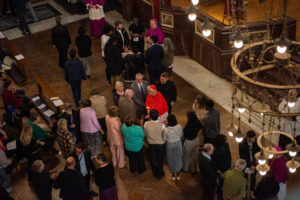
Given at the Province Schools Mass at Westminster Cathedral on the feast of Our Lady of Walsingham, 24 September 2015.
‘Where do I belong?’ It’s a key question for every human being.
Witness the migration in recent months of so many hundreds of thousands from Africa and Asia, each in search of a place to belong. It’s the key to these readings.
Jesus wants his mother to know she belongs to John. It’s the very last thing Jesus does before he gives up his spirit: he turns to John, the beloved disciple, and to Mary and tells them she now belongs to him. We read, ‘from that moment the disciple made a place for her in his home’.
This feast used to be called the Feast of Our Lady of Ransom because we hear Paul tell us in the first reading that we have been (effectively) ransomed, ransomed by Christ. We are no longer slaves, he says, but heirs: in other words, we belong to Christ. We might say, we have come home to him.
He told us while he was alive, ‘Make your home in me’.
‘Make your home in me as I make mine in you.’
I have a good and spiritual friend who said to me, ‘you know, I can understand the second half of that phrase: when Jesus says, “As I make my home in you”. But the first part I struggle with: “Make your home in me”’.
She seemed to have a point; and, as I reflected on her comments, other sayings occurred to me where Jesus seemed to be saying something similar: ‘I am the vine you are the branches … Remain in my love … Cut off from me you can do nothing.’
Then it struck me. He means we should inhabit him – and in that sense make our home in him: inhabit him in prayer; inhabit him in those we encounter; inhabit him in Scriptures like this one.
Enter this crucial moment in the life of Jesus by meditating on it a while. Begin by imagining yourself, if you can, at foot of the cross. Imagine yourself to be Mary; hear Jesus tell you belong to John. Imagine yourself to be John: hear Jesus tell you to make a home for Mary. Make a place for her in your own heart; let her know she belongs in your heart too.
A sense of belonging goes very deep in our schools and in our parishes. At least it should do.
Many of you will have seen the research project commissioned by the Bishops of England & Wales which interviewed parents about their sense of belonging.
Published a year ago, it was called, ‘Challenges & Opportunities for the New Evangelisation: a Case Study of Catholic Primary School Parents in England & Wales’.
What was significant about it was that it allowed us to hear the voices of parents who send their children to Catholic schools in a way we’ve not heard them before. Yes, we have been listening to parents for decades – but not in quite this way. Parents from Primary Schools in every province of England & Wales were systematically interviewed and their responses collated.
What struck me on first reading the report was that nearly all their responses were about belonging. They expressed a strong sense of belonging to the schools to which they sent their children. They felt much less a sense of belonging to their parishes.
But they communicated, almost without fail, a desire to belong more.
I found it very moving to hear the voices of parents saying they find it difficult to express their understanding of the Catholic faith in an articulate manner. Many said there are gaps in their faith knowledge which lead to feelings of embarrassment, isolation and confusion. They want help – but it mustn’t be pitched too high: they plead for a faith formation which isn’t highbrow.
Time and again they affirm what they receive from the school: the ethos, the quality of staff, the quality of pastoral care, the high academic standard and the sense of belonging to a community of faith. But they feel they hardly belong to the parish.
They feel awkward even about entering the church – for fear, they say, of making a mistake, for fear of not knowing what to do. They feel they know no one in the parish; and that no one would know them.
They would welcome an invitation from the priest to come with their children after school, to look round the church and be able to questions about what happens where.
They yearn for liturgy about which their children can be enthusiastic, good child-centred celebrations.
Strikingly, they expressed deep appreciation where schools provided a pastoral worker who acted as a liaison with the parish. They rejoiced in the regular presence of priests at school. To be known by name by a representative of the parish was clearly important; to be known by name.
It is significant that not one of the parents shared that they no longer attended Mass.
Not one self-identified as a Church-leaver. They identified as Catholics. I believe this is significant for our understanding of their sense of belonging.
It puts the onus on parishes to nurture their sense of belonging to the parish. The school is clearly a threshold for the parish: this is something we need to reflect on long and hard. Because, for so many, the school is the front door.
And, insofar as it’s desirable and appropriate from the school’s point of view, parents need to meet people from the parish there. I don’t mean ordinary folk but the experts: clergy, lay chaplains, pastoral workers: all properly screened and accredited, of course, and their presence desired by the senior management. Because this report is showing that their presence could make all the difference to a family’s sense of belonging.
There’s so much more that is said in the report. It makes me want to use this occasion, as you gather as schools of the province, to thank you for all you do to make our families feel at home in the Church. You are clearly nurturing that sense of belonging for which parents are saying they yearn. If anyone outside of here doubted the importance of Catholic schools to maintaining Catholic identity they need only hear what these parents are saying up and down the land.
I would urge you to read the report for yourselves; discuss it in your staffrooms, take it to your clergy. I’m confident that, like me, you’ll find yourself thinking, as you read it, ‘I wonder how we could help these parents more; help them understand their faith better, help them feel more at home in the parish, help them feel they belong.’
Pope Francis tells us we must look with love and respect at those who know themselves to be Catholic but do not feel part of their parish. He urges us to look on them with the same gaze of love as they would have seen in the eyes of the Good Shepherd.
To paraphrase him, he says, imagine the love with which God looks on a mother tending her sick children: she may barely know the Creed but she clings to her rosary.
Imagine the love with which God looks on a family who pour their hope into a candle lighted in honour of Mary, whose help they desperately seek. Imagine the love with which God looks on a poor sinner who gazes with tender love towards a crucifix.
Have a heart, he’s telling us. And let them know they belong.
In his reflection on belonging, Pope Francis takes us back to where we started: standing with Mary at the foot of the cross. In his moment of greatest need, Jesus remembered that Mary needed to know where she would belong.
Let us ask her to bless the families in your care; ask her to pray for our schools that they grow to be places of ever-deeper Christian welcome; pray that they be thresholds of faith, thresholds indeed of an encounter with nothing less than the living Lord.