
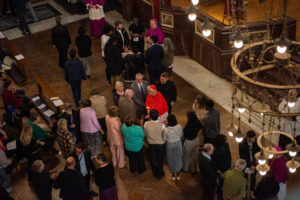

Scripture is filled with divine walking, which reveals God’s commitment to accompany every person. When, as the Church, we walk with people we are mirroring this. The annual March for Life features walking, which is primarily a relational moment. As Amoris Laetitia repeatedly insists, life is always received within relationships.
Understood in this sense, walking is a pro-life posture, as human dignity is upheld through relationship, not isolation. The amniotic fluid surrounding a child is the earliest sign that human life is sustained through intimacy, not isolation. This gathering is one where walking expresses a very public relational dignity. Life is not protected from a distance but in close proximity, with shared steps.
The right to life, as Pope Francis highlighted, is inseparable from the right to be loved, accompanied, welcomed and supported. These life ethics are then captured in a wider ecosystem of family, community, and social structures. It is here that we learn to adjust our steps to those whom we accompany: staying close, we walk not only with the unborn but the wounded, we affirm their right to live, to grow and be loved.
Attacks on one aspect of human life, be it abortion, euthanasia, exploitation of others, and neglect for the poor, for example, are in reality an attack on the complex beauty and diversity of human life. This sense of defending life is captured in The Joy of the Gospel by Pope Francis, ’The defence of human life is closely linked to the defence of each and every other human right’ (213).
Accompaniment across life is not an abstract moral decision. Walking at the ‘March for Life’ is something that speaks of movement, accompaniment and shared journeying. It is not a protest movement but a shared ecclesial journey of the People of God. The walked witness to life is a very public act of accompaniment, with a symbolic defence of life through presence, mercy and relational solidarity. We walk with the unborn, the elderly and families in crisis. Accompaniment, as Amoris Laetitia states, is not a concept but a movement.
In the light of this, life is not merely defended, it is walked with, carried, supported and grown. This is the language of Amoris Laetitia, where we are called to walk alongside those whose lives are fragile, as others walk with us.
Last year, my wife and I accompanied two couples preparing for a Convalidation. Both were expecting babies. One lost their baby, in the same hospital where the other baby was born prematurely. We moved down the corridor straight from consoling one couple to rejoicing with the other, moments where the ‘art of accompaniment’ became concrete, embodied and demanding. Walking with people means meeting them in real circumstances. In a pastoral care setting this involves not only feet, but feelings.
In reality, the ‘March for Life’ happens every day. This is support that is not offered at a distance: it is an accompaniment that requires movement to the person. Christian love is embodied. Jesus did not accompany from a distance: he walked on the road, touched wounds, ate with sinners and carried crosses. Accompaniment is incarnational. The pastoral vision of Amoris Laetitia is of a Church that walks with families, not a Church that advises families.
Good Counsel Network is a life-affirming women’s organisation which offers moral support, support to find medical help, legal advice and practical help to women seeking abortion.
Life is a UK-based pregnancy support charity that provides emotional help, housing, and practical aid to people facing unexpected pregnancies or pregnancy loss.
Hans on UnSplash