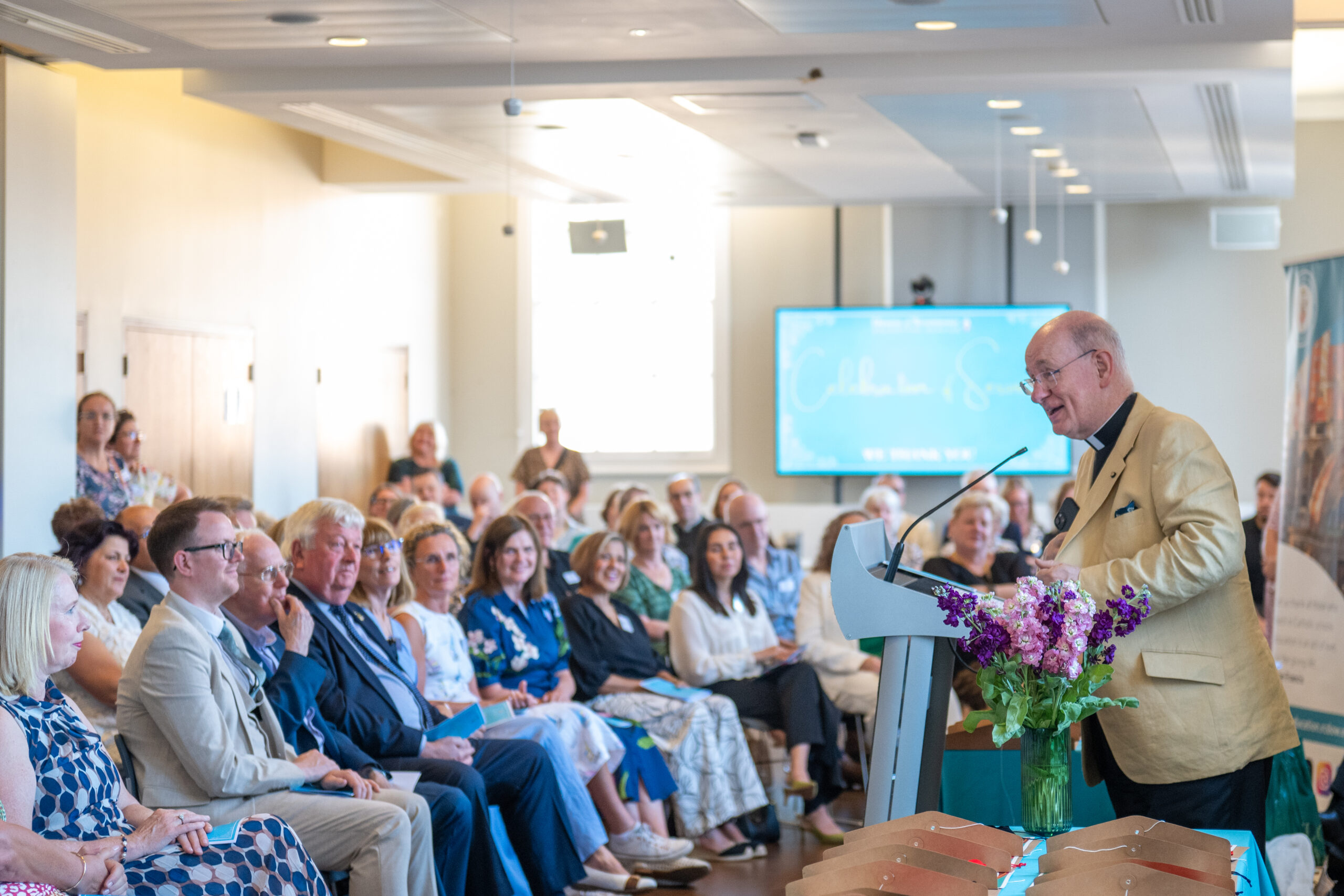

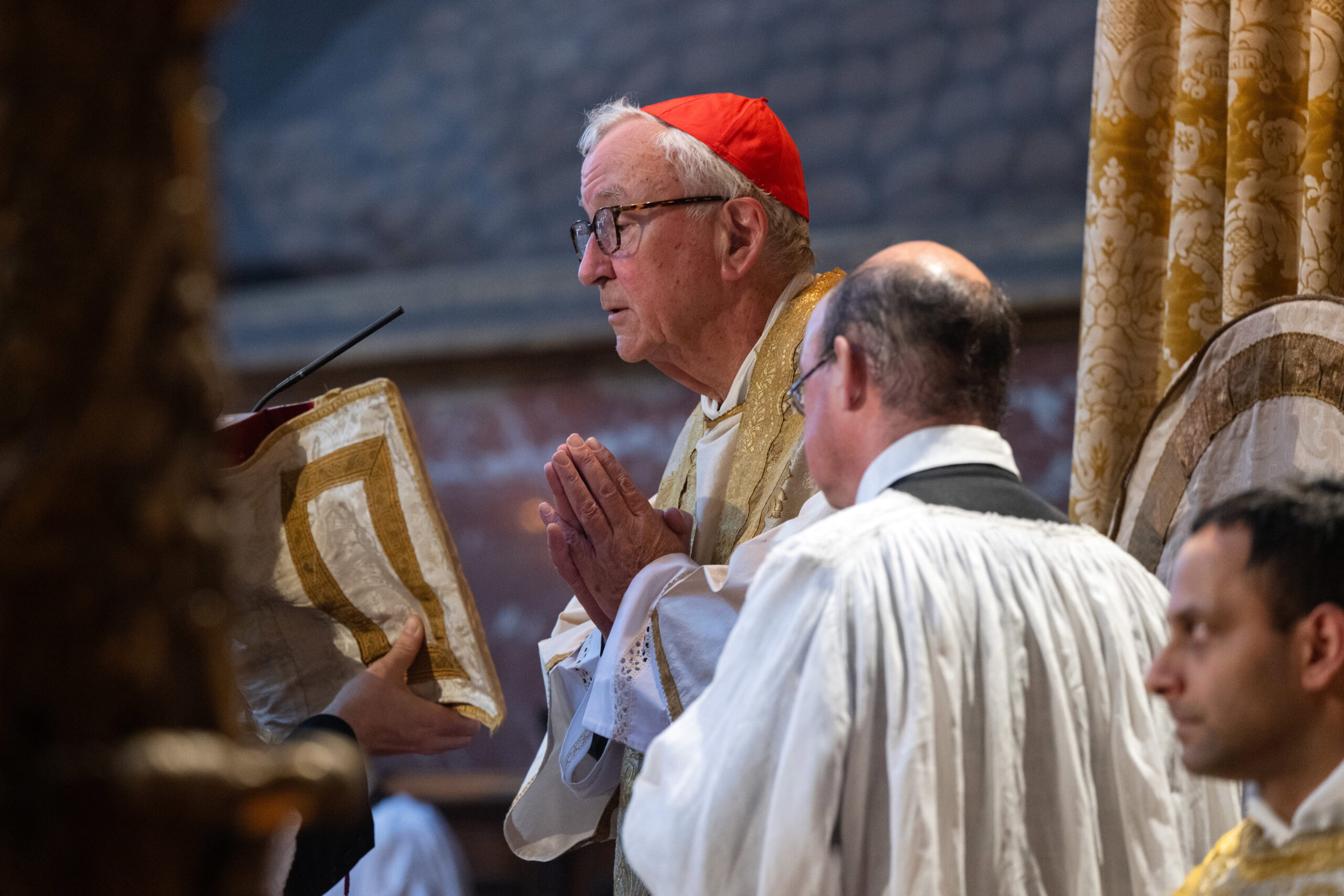
Homily given by Cardinal Vincent Nichols on 26 May 2026 at the London Oratory, for Mass celebrating the feast of St Philip Neri.
Today’s solemn celebration of the Feast of St Philip Neri offers a challenge for us all. It is a challenge for his followers, this community of the Congregation of the Oratory and this parish as you seek to match up to the inspiration of your founder. It is also something of a challenge for me in giving this homily, for my knowledge of this great saint cannot compare to that of many here this evening.
Indeed, my knowledge can be summed up in two of the titles by which St Philip is known: Apostle of Rome and Apostle of Joy. My more personal image of this great saint comes from my student days in the Venerable English College. There it was well known that whenever St Philip met College students preparing for priestly ordination, he would greet them with the words ‘Salvete, flores martyrum’ – ‘Greetings, flowers of martyrdom’. In a way, this salutation summed up his titles: he was a very significant figure in Rome and one who could see the joy even in martyrdom.
His title as Apostle of Rome – or second or even third Apostle of Rome, after Paul and Peter, of course – came from his steadfast work with those whose needs, spiritual and practical, were greatest in that city: the poor, the destitute, the sick, together with the steady stream of weary pilgrims arriving in Rome.
Much of this work he carried out as a layman but eventually, in 1551, he was ordained a priest and so moved gradually to the foundation of the Congregation in 1575.
As an Apostle of Joy, St Philip had a great ability to engage with people in so many different ways, through gentleness and kindness, or through conversations that could, if necessary, be provocative; through sensitivity to their situation, to their vulnerability and limitations; through the attractiveness of music and regular preaching – of the highest standards, of course!
But, as I said, there are many here who can give a far more complete and polished account of his life, drawing out so many of his gifts, in patterns of prayer, in community living and structure, in his work in both teaching and the relief of poverty in all its forms.
Now let us turn to the Scriptural readings we have just heard.
The Gospel passage from St John, about the vine and its branches and our heavenly Father as the vinedresser, takes us to the heart of this Saint, a heart sometimes depicted as burning with love of the Lord, indeed enlarged with that love. This is the one necessary thing: a radical desire to be close to the Lord, one with the Lord, thoroughly at home in the Lord, constantly aware of Him and always warmed by his gaze and his love. ‘Abide in me and I in you’ are his words to each one of us this evening. It is the challenge of this noble saint. Jesus tells us quite bluntly:
‘Apart from me you can do nothing.’ Going it alone, sooner or later we will wither, and withered branches are burned. But bound to Jesus, grafted into him, we can ‘bear much fruit’ and, as he says, ‘prove to be my disciples’, giving glory to our heavenly Father.
This is our first and daily challenge as presented by St Philip: that we live close to the Lord, within the sanctuary of our inner life, within the ‘cell of my heart’, to use a phrase of St Catherine of Siena. Please take this with you from our magnificent celebration this evening.
St Paul, in the second reading from the Letter to the Philippians, leads us to appreciate some aspects of the fruit that we are to bear from our life in the Lord. In this passage he highlights these: that we are constantly joyful, that we are peaceful, and that we steadily seek ‘whatever is true, whatever is honourable, whatever is just, whatever is pure, whatever is lovely, whatever is commendable’. The joyful apostle of Rome seems to have understood this so well and helps us, in his leadership, to emulate this quest in our own lives.
Yet life is not so simple. In many situations, the discernment of what is just is complex. Some will commend one course of action, others the exact opposite. And what exactly is worthy of praise, or commendable, in the setting of a conflicted family, or a business in jeopardy?
St Paul, and St Philip, remind us to be centred not in anxiety but in prayer and to let our requests be known, remembering always that ‘The Lord is at hand.’
And this brings us directly to the first reading, with its sharp focus on the ‘spirit of wisdom’. Wisdom is a gift to be esteemed above ‘sceptres and thrones’ above ‘priceless gems… gold… silver… health… beauty’, topics which fill many a magazine and which trouble many a heart. The writer proclaims that she, wisdom, is the mother of all these gifts, helping us to keep all these things in a true perspective: to learn without guile and give without grudging.
The same underlying quality of joy emerges in this reading too. Yes, we face many daunting challenges and complex problems in our world today, yet here we can absorb a confidence, a sureness, a quiet determination that in being close to the Lord, sustaining a profound faith in his presence, using our intelligence, both mental and emotional, each one of us, without exception, can bear fruit in our lives, to the glory of God – as St Philip did.
Yesterday, as you will know, Pope Leo published his first Encyclical Letter. Its title carries those same tones of sure and determined faith and confidence. It is entitled ‘Magnificent Humanity’ and it is a paean of praise of the innate dignity of every human person, created from the love of God and in God’s very own image and likeness.
Its core content addresses the issues of Artificial Intelligence and the enormous changes and challenges being brought about by the digital revolution. Pope Leo says these developments have to be ‘disarmed’. And by that he means held to account, constrained by agreed regulation, to ensure they genuinely serve the good of all humanity rather than enslave and impoverish the many for the benefit of the few.
He has an appeal for each of us. In his press conference yesterday morning he said: ‘With humility the Church wishes to enter conversations on the future of Artificial Intelligence, not on the basis of expertise, but because the Church has wisdom concerning the human, which our time desperately needs’. His invitation to us all is to listen to each other, to have courage, and to build not a Tower of Babel but a Holy City where all people can live together and with God. He urges us: ‘Stay awake as artisans of hope. Keep on building the worksite of our times’, commending us to the intercession of our Blessed Mother.
Saint and Pope. The same appeal to Wisdom; the same joyful and confident faith; the same determination to keep us from Babel’s pomp and pride; the same rootedness in the Lord who gives us hope, who guides our steps and who holds us safe. On this his splendid feast day, may St Philip look down from heaven and pray for us all and especially for our Holy Father, Pope Leo, in his faithful and incisive service of the Church.
Amen.