

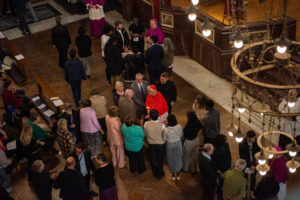
Given at Westminster Cathedral at the Red Mass on Tuesday 1st October 2019.
‘I can’t understand why you go and visit people in prison. They’ve done such awful things.’ That’s what my barber says to me every January. The conversation is always the same.
‘What did you do on Christmas Day?’, he asks. I tell him I went to celebrate Mass in prison.
‘Why?’, he asks.
‘Because I feel sorry for the prisoners.’
Pope Francis too has always felt sorry for prisoners. It was touching to hear that affirmed in the BBC documentary last month on the Vatican, where he said he has always been attracted to prisons, all his priestly life. I was thinking of Pope Francis as I prepared to celebrate Mass in Holloway one Christmas. I told the women how much the Holy Father would be thinking of them today; how he says, ‘Every time I walk past prison walls, I tell myself, “It could have been me; it could have been me on the other side of that wall.”’ And they burst into long applause and wolf-whistling.
Even in their continued incarceration, they received from his message something of the liberation we hear promised today by God on the lips of the prophet Isaiah, the freedom to rejoice in God’s mercy.
Nothing speaks more loudly of that mercy than when Pope Francis goes into prison on Maundy Thursday to do what Jesus did, to wash prisoners’ feet. Every Maundy Thursday, I find myself thinking, ‘What must have been the look in Jesus’s face when he came to wash the feet of Judas?’ It must surely have been a look which said, ‘Judas, whatever you do to me, know that I forgive you.’
It must be the same look of mercy that every prisoner receives when Pope Francis washes and kisses his feet.
It’s striking to note that ‘mercy’ is the word Pope Francis has spoken more than any other these six years he has been Pope.
He’s at pains to help each of us to understand that, as long as we live, we still have a last chance, that mercy is being given a last chance. And we should understand what seem to be Jesus’s most judgmental sayings to be, in fact, an act of mercy.
So it is that, when Jesus tells us how the Son of Man will come to divide the sheep from the goats, saying to those on one side of him, ‘I was hungry and you gave me food’, to those on the other side, ‘I was hungry and you gave me no food’, he’s being not so much judgmental as merciful towards us.
He’s saying it’s not too late, it’s never too late to repent and to start showing mercy yourself, until it’s too late.
We celebrate today someone who really understood God’s mercy.
I mean St. Thérèse of Lisieux, whose feast it is today. Her Little Way is sometimes mistaken for a childish way. But the reason she’s a Doctor of the Church is that she understood Jesus’s saying, ‘Become like little children’, to be a call not to be infantile at all but a call rather to the deepest, most adult trust in God’s mercy. Nothing captures this better than her correspondence with the young Fr Maurice.
Sr Therese was in the last months of her life when she was asked to correspond with a young missionary by the name of Maurice.
You can read for yourself her beautiful letters to him in ‘Maurice and Therese: The Story of a Love’. As the life is draining out of her, Therese tells Maurice that she will soon be going to God; that she’s left him certain precious items, like her crucifix; and that she will remember him before the Throne of Mercy. She believed it would be their last communication.
But Maurice can’t help himself writing one more letter in which he expresses all the anxiety that is within him. ‘What I find most difficult to bear’, he writes, ‘is the thought that you will see from heaven just how bad I really am; what a sinner I’ve been; what a poor priest I make.’ By this time Therese is bed-ridden. But she makes one more supreme effort to raise herself and write a last letter in which she addresses him in the most tender way, saying, ‘Dearest Maurice, you mustn’t feel such anguish in your heart; you have rather to believe that, when I’m in heaven, I shall be given eyes to look on you with all the compassion that is in the Father’s heart.’ ‘I shall share with you in the infinite mercy of the Lord.’
Our thoughts are very much with another holy man, Blessed John Henry Newman, anticipating as we are his Canonisation in two weeks’ time. For me his greatest work was, ‘The Dream of Gerontius’, because it’s all about mercy. Gerontius has died and is being borne up to heaven by his guardian angel. He asks to see God. The angel takes him to the outer edge of God’s presence. In an instant, Gerontius knows his need for repentance. ‘Take me away!’ he cries. And his angel takes him to a place of soft light and gentle sounds. The angel tells him, ‘Now you are in purgatory; and here you will prepare yourself to come fully into God’s presence. I myself will return to take you there. Meanwhile, the prayers of your loved ones and Masses offered for you on earth will help and comfort you.’ What a comfort. What a call. The call to start being merciful ourselves during our life on earth. For, of course, it is the merciful who shall have mercy shown them.