
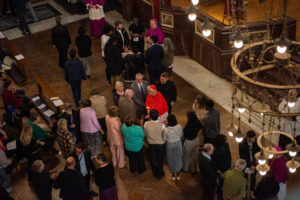
Given at the concluding Mass of Quarant’Ore at Westminster Cathedral on 2nd June 2018
At the top of many late-medieval and Renaissance crucifixes, one often sees the symbol of the pelican feeding her young. In the text called the Physiologus, an early Christian work which appeared in the second century in Alexandria, Egypt, we read stories of the symbolism of the mother pelican feeding her little baby pelicans which is founded in an ancient legend which preceded Christianity. The legend was that in time of famine, the mother pelican wounded herself, striking her breast with the beak to feed her young with her blood to prevent starvation. Another version of the legend was that the mother fed her dying young with her blood to revive them from death, but in turn lost her own life. Quickly we can see how the symbol of the pelican becomes a symbol of Christ’s redemption through the power, yet for many the folly, of the cross. Christ gives himself on the cross, pours out his blood in love for us and all people, so that we might have life in him and grow in him to the Father.
The symbol of the pelican is most well-known is the sixth verse of the hymn Adoro te devote, written by St Thomas Aquinas and translated into English by Gerard Manley Hopkins. It reads,
Like what tender tales tell of the Pelican
Bathe me, Jesus Lord, in what Thy Bosom ran
Blood that but one drop of has the powr to win
All the world forgiveness of its world of sin.
It is depicted in the Blessed Sacrament Chapel here in the cathedral.
At every mass we enter once again into this saving mystery of Christ’s blood poured out on the cross, gaze upon the oblation of Christ on the cross and hear the powerful words of the holy exchange between earth and heaven, which echoes in our hearts: ‘This is my body given for you’, ‘this is my blood, the blood of the covenant which is to be poured out for many.’ In holy communion we enter into this holy exchange and receive the true bread and the holy blood of eternal life. Jesus says, ‘Do this in memory of me.'
We experience the dynamic movement from the sacrifice of Christ on the cross, to being nourished by the bread of heaven and food of life so that ‘God gives me life, God lives in me’. For St Teresa of Avila, receiving Jesus in Holy Communion was the most important moment in the day and led to profound reflection on the Eucharist. She writes, ‘the devil will make you think you find more devotion in other things and less in this recollection after communion’ (The Way of Perfection 35.2). However, ‘in no matter how many ways the soul may desire to eat, it will find delight and consolation in the most Blessed Sacrament… there is no need or trial or persecution that is not easy to suffer if we begin to enjoy the delight and consolation of this sacred bread’ (34.2). His presence abides in each one of us so that we can sing, ‘He feeds my soul, he guides my ways, and every grief with joy repays.’
During the Quarant’Ore, we have allowed the gaze of the Lord to fall upon us and responded heart to heart to ask his grace and favour. The hymns of the Mass help us to penetrate more deeply into these mysteries.
Every celebration of the Mass directs us towards the final Messianic banquet in heaven and so the food of life gives us the pledge of immorality to trust more deeply in the Beloved Lord in heaven above, where Jesus ‘thou awaitest me’, and we will ‘gaze on thee with changeless love’. The gift given on earth is the promise of the fullness of the gift to be given in heaven.
Now we prepare to come down from the mountain where we have met the Lord and go out to be his Body in the world. Gathered around the altar as the Body of Christ, we receive the Body and Blood of Christ from the altar to become more fully his Body in the world. We offer ourselves in service to our brothers and sisters. When we are sent out from Mass, we have the work of God to take to the world. Pope Emeritus Benedict XVI summed up this dynamic and path towards our completion in God in his letter after the Synod on the Eucharist:
‘The act of adoration outside Mass prolongs and intensifies all that takes place during the liturgical celebration itself. Indeed, only in adoration can a profound and genuine reception mature. And it is precisely this personal encounter with the Lord that then strengthens the social mission contained in the Eucharist, which seeks to break down not only the walls that separate the Lord and ourselves, but also and especially the walls that separate us from one another.’ (Sacramentum Caritatis 193)
He continues, ‘I therefore urge all the faithful to be true promoters of peace and justice: All who partake of the Eucharist must commit themselves to peacemaking in our world scarred by violence and war, and today in particular, by terrorism, economic corruption and sexual exploitation’ (245). Precisely because of the mystery we celebrate, we must denounce situations contrary to human dignity, since Christ shed his blood for all, and at the same time affirm the inestimable value of each individual person (89).
O Sacrament most holy, O Sacrament divine, all praise and all thanksgiving be every moment thine.