
Given on Sunday 2nd March 2025 at St. Andrew’s University Chaplaincy.
Hope shines out from the Transfiguration of Jesus, which transforms human reality and joins earth and heaven together. All creation is drawn into the mysterious plan of God to create a new heaven and new earth, the holy city, the new Jerusalem, where God will dwell with his people. In that kingdom, there will be no more tears, no more mourning and weeping, no more pain; the peace of Christ will reign. We can hold this hope in our hearts and share it with others, because of the love of God has been poured into our hearts through the Holy Spirit. We can hold firm to the steadfast love of Christ who desires to redeem all people. He loves us, has saved us, and now walks with us in daily life.
Archbishop (now Saint) Oscar Romero of San Salvador – whose passion for justice first inspired me many years ago – spoke of the hope of the Transfiguration and the transformation of the human person by God’s grace ‘from glory into glory’. [1] Each year he preached on the feast of the Transfiguration which is the national feast of El Salvador. He observes that the five who gathered with Jesus on the mountain had at one time been men of violence; Moses had slain an Egyptian, Elijah ordered the slaying of the prophets of Baal, Peter drew his sword against the soldiers coming to arrest Jesus, James and John, the sons of thunder, wanted to call down fire down on the Samaritans who were inhospitable to Jesus. They all witness to the hope of God’s grace as they have been transformed through their encounter with the living God. For Romero, Tabor speaks of glory and the need for the transformation of violent attitudes and actions by God’s grace and repentance. Christ’s Kingdom conquers evil, suffering and death.
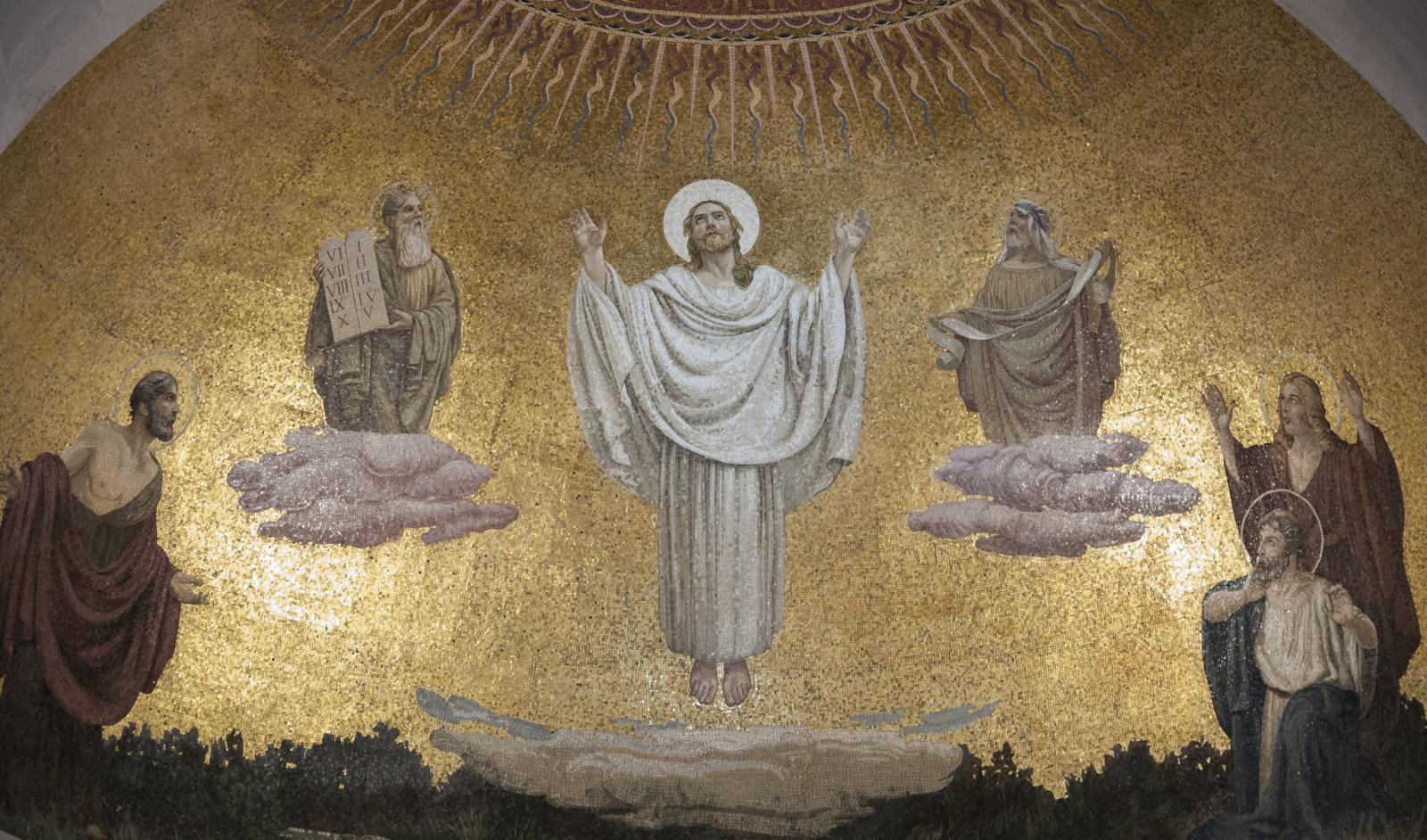
Romero’s theological insight on the Transfiguration has been researched and published by Prof. Edgardo Colon-Emeric of Duke University in his work, Theological Vision: Liberation and the Transfiguration of the Poor. Visiting Tabor in 1956, Romero described the mountain in the following way, ‘It resembles an altar raised to the glory of God’. He continues, ‘The Basilica of the Transfiguration is a true poem in stone to the glory of the Transfigured One. When the sun strikes the polychromic stained glass of the apse, it seems as if the ‘luminous cloud’ has again descended on Tabor. The lovely mosaics that represent the other four transfigurations of Jesus (his birth, his Eucharist, his passion, and his resurrection) are illumined. And when the priest cloaked in the glory of that basilica receives the privilege of celebrating the Mass on the Feast of the Transfiguration, it seems as if he feels something akin to the ecstasy of Saint Peter: Lord it is good to be here.’[2] These mosaics witness to the incarnation, the cross, the resurrection and Christ’s glorification. They also reveal the telos or goal of the person redeemed in Christ who responds in faith and love.
Jesus climbs the mountain with his disciples to the place of the privileged encounter with God. The disciples, like us, fall asleep. Yet this is their prelude to a vivid encounter with the Glorified Christ. The Transfiguration encourages us to pray which leads to new sight and understanding and invites our response.
St Luke tells us that while he was praying, Jesus’ ‘face changed in appearance and his clothing became dazzlingly white’ (Lk 9:29). The richness of these images is deepened when we draw upon the parallels from the Old Testament.
In one vision, the prophet Daniel tells us that when ‘the Ancient of Days took his seat; his clothing was as white as snow’ (Dan 7:9). He sets up his throne and is surrounded by the angels and countless worshippers. At the judgement which follows, the forces of evil are destroyed, the beast was killed and his body destroyed along with other beasts. Then there appears ‘one like a son of man’ who is given dominion, glory and a kingdom of everlasting dominion. The prophet Daniel points to Jesus, the Son of Man, who reigns in the glory of heaven.
After Moses met God on Mount Sinai, his face shone so brightly that he needed to wear a veil to meet his people. On Tabor, Peter, James and John have a face-to-face encounter with the glorified Jesus which leads to joy and delight. They wish to bask in this glory and build tents. The voice from heaven proclaims, ‘This is my Son, my Chosen One’. Jesus is revealed as the image of the invisible God, the Face of God. He is also the New Tent because the Son of God became flesh and pitched his tent amongst us. Peter, John, and James do not need to make tents. They are with Jesus who is the Tent. The dazzlingly white garments also point towards the two men in white garments who testify that Jesus has been raised from the dead (Luke 24:4) as well as the two men in white robes who witness Jesus’ ascension into heaven (Acts 1:10).
Jesus converses with Moses and Elijah about his exodus (or death) which he is to accomplish in Jerusalem (Luke 9:1). The soldiers who mock Jesus on the cross and offer him sour wine. They taunt him with the title ‘Chosen One’ (Luke 23:25). Jesus who is seen in glory is also the Suffering Servant. The cross must be embraced to receive the gift of the resurrection and the ascension. He is the fullness of God’s revelation who will show his wounds in a glorified body to the doubting Thomas.
Archbishop Romero passion for preaching about the Transfiguration is deepened by the theology of St. Irenaeus and his defence of Christian faith against the Gnostics. He reflects on how his theology helps to illuminate the dignity of the poor and suffering person in El Salvador.
In his well-known aphorism, St. Irenaeus writes, ‘For the glory of God is a living man; and the life of man consists in beholding God.’ (Against the Heresies Bk 4).[3]
This theology argues against two modern-day heresies recently highlighted by Pope Francis; first, the danger of a new Gnosticism; second, a new Pelagianism (Gaudete et Exultate (2018) 35).
A new Gnosticism places its focus on ‘a certain experience, or a set of ideas and bits of information’ which separates the intellect from the flesh and has the danger that a person become incapable of touching the suffering Christ in the flesh of others (GE 37). This approach disembodies the mystery of Christ and the mystery of being human. It is all about ideas rather than charity!
A new Pelagianism places focus on the autonomous self and the will. It is forgotten that everything “depends not on human will or exertion, but on God who shows mercy’ (Rom 9:16 and that ‘he loved us first’ (cf. 1John 4:19) (GE 48). It is all about the self rather than a humble need of God’s grace!
In contrast, St Irenaeus presents a theological anthropology which reflects the transformative nature of the divine call to holiness, as attested by St Paul: ‘And all of us, with unveiled faces, seeing the glory of the Lord as though reflected in a mirror, are being transformed into the same image from one degree of glory to another’ (2 Cor 3.18).
True human life is found in the acknowledgement of God as Creator, his Son as Redeemer and the Holy Spirit who draws into the love of God. The vision of the transfigured Jesus on Tabor reveals the mystery into which human beings are called. We are called into that face-to-face encounter with Christ. We grow in holiness from the face-to-face encounters of love with our neighbour as equals.
This encounter of love became very real during the CCJ study tour of Poland which I shared with the chaplain Rev. Donald McEwan. I remember Moshe of our group showing us a list of all his family members who were murdered during the Holocaust. Rows upon rows who are now recorded in The Book of Names at Auschwitz. It was a very emotional experience calling for love lived with humility and in need of God’s grace.
Holding together flesh and spirit, Archbishop Romero understood that in the context of the situation in El Salvador, St Irenaeus gives a hermeneutical key for his life and mission. He changes the words of Irenaeus and preaches, ‘Gloria Dei, vivens pauper’, The Glory of God is the living poor. The Transfiguration reveals the God-given mystery and the dignity of the poor woman or man. Today, this recognition is important as often migrants are presented as numbers without a name, refugees as people without a history and family, the sick as a nuisance, prisoners as a cost to the taxpayer. Only when we know the names of those who are poor will we truly be living the call of the transfiguration and all its implications.
Charles Wesley’s great hymn Love Divine, All Loves Excelling praises the glory of the Incarnation. God who is Love sends his Son to become flesh in the womb of Mary, the virgin, ‘Joy of heav’n to earth come down’. We pray for the indwelling of the Holy Spirit and the grace of God which transforms us, heals us and works in us and through us. The hymn sings of the power of the Transfiguration for every person as by God’s grace we are:
‘Changed from glory into glory
Till in Heav’n we take our place,
Till we cast our crowns before thee,
Lost in wonder, love, and praise.'
Bishop John Sherrington
[1] Inspiration from Edgardo A. Colo-Emeric, Óscar Romero’s Theological Vision: Liberation and the Transfiguration of the Poor.
[2] Ibid, 219.
[3]Gloria enim Dei vivens homo, vita autem hominis visio Dei.