
By Fr Lawrence Lew OP
London is home to Catholics from all over the world. The diverse cultural expressions of our Catholic faith that the various ethnic communities bring with them to this city enriches our diocese by giving us a vivid sense of the catholicity of the universal Church. We feel rooted in our common apostolic faith, and we rejoice to see that the command to ‘make disciples of all nations’ has resulted in beautiful examples of an inculturated faith that is full of devotion, warmth, and deep spiritual joy. This is what I experienced on Saturday 20th October when the Filipino community, including a representative of the Philippines Ambassador, gathered in force at the Diocesan Shrine of Our Lady of the Rosary in Haverstock Hill to honour ‘Mama Mary’ in the month of her Holy Rosary.
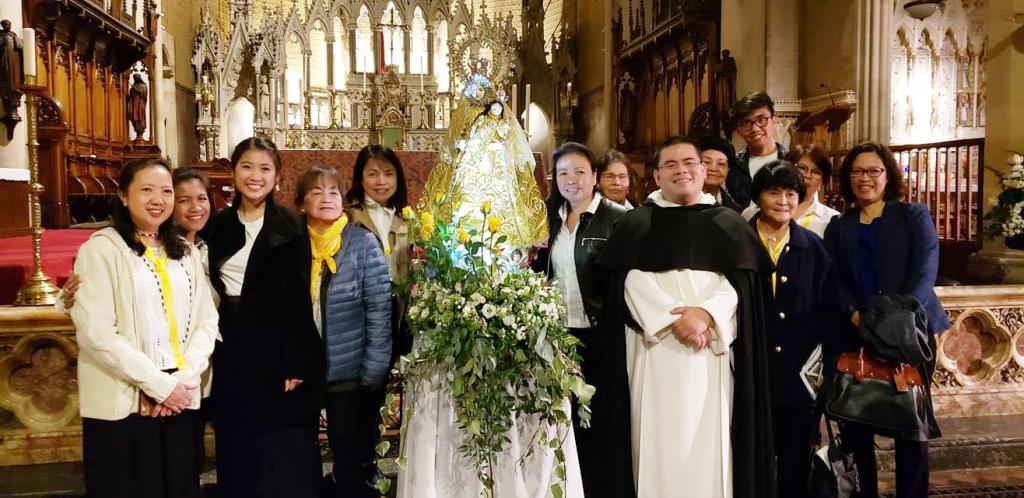
The Philippines, which is Asia’s only Catholic country, has a particularly ardent devotion to Our Lady and a great love for music and singing. In the past year the Filipino community have held monthly sung Masses in St Dominic’s Priory (the Rosary Shrine church). They have been drawn to London’s largest Marian Shrine by Our Lady, particularly by the gleaming presence of the statue of Our Lady of the Rosary of Manaoag. The original miraculous statue is enshrined in the much-visited Basilica of Manaoag in Pangasinan, in the north of the Philippines. London’s Rosary Shrine houses the only authorised replica of Our Lady of Manaoag in the United Kingdom, a gift from the Dominican friars who serve the Manaoag Basilica. The Filipino community in London organised the first procession of this statue recently, and the occasion was marked by two other unique ways of praying the Rosary.
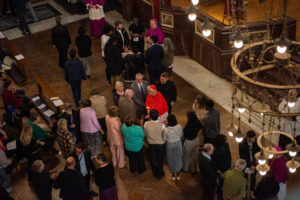
Firstly, a giant Rosary formed from lanterns was constructed and it was carried in the torchlight procession, with one person holding each lantern-bead of this so-called ‘Living Rosary’. As Our Lady of Manaoag was taken in procession around the Rosary Shrine church, passing each of 15 separate Rosary chapels and altars in the church, the Living Rosary followed behind together with hundreds of pilgrims holding candles. The Joyful Mysteries of the Rosary were prayed during this procession, with each individual person in the Living Rosary leading the appropriate prayer. I was especially moved to hear the different voices of our parishioners and pilgrims, successively saying the Hail Mary, decade after decade. The various intonations and accents added colour and life to the praying of the Rosary, emphasising once more the diversity of the Catholic Church, and yet showing our union in devotion to the Mother of God, united in following her Son, represented by the Crucifix carried at the front of the procession.
Secondly, the decades of the Rosary were punctuated by a Spanish song, Virgen Divino which is part of a cycle of prayers and songs in Tagalog, Spanish, and Latin performed during and after the praying of the Rosary. It is called the Rosario Cantada, and this is the first time it has been sung outside the Philippines. Lesther Encarnación, the ethnomusicologist who led the singing, explains: ‘the music and performance of Rosario Cantada serves as a reminder of our unique Filipino cultural and musical identity. It defines our devotion to the Divine and at the same time it represents us: the community, the Filipino diaspora, in multicultural London’.
When Cardinal Vincent inaugurated the Rosary Shrine in his diocese, he gave the shrine the mission of promoting the Rosary, and he prayed that ‘all who come on pilgrimage to this place may be drawn deeply into the mysteries of our salvation’. These distinctly Filipino ways of praying the Rosary that we participated in, and the Filipino community’s deep devotion to God and Our Lady of the Rosary, which was evident on this occasion, surely fulfilled the Cardinal’s prayers. We look forward to next year’s processions, and to the other Filipino celebrations coming up in the Rosary Shrine including the Simbang Gabi novena of Masses (16th – 23rd Dec, 7:30pm nightly).