
Bishop John Sherrington, the Lead Bishop for Life Issues for the Catholic Bishops’ Conference of England and Wales, has condemned Clause 10 of the new Public Order Bill, reiterating concerns it will lead to the curtailment of freedom of speech for people of faith.
The clause, set to be signed into law, criminalises a range of activities within a 150m perimeter of an abortion facility, otherwise known as a ‘buffer zone’.
Bishop Sherrington said: 'Throughout this Bill’s passage through Parliament, the Catholic Bishops’ Conference of England and Wales has reiterated our concern that that this proposed legislation, despite any other intent, constitutes discrimination and disproportionately affects people of faith.'
Commenting on what could be illegal within a ‘buffer zone’, he said: 'These could very easily include many things that should never be criminalised such as prayer, thought, peaceful presence, consensual communication and practical support if they are deemed to influence or interfere with access to the clinic.
'Politicians went so far as to vote down an amendment which would have protected silent prayer and consensual communication in such spaces, and that would have initiated a review into whether such legislation was needed.'
Bishop Sherrington cited a 2018 Home Office Review which found that there were already adequate laws in place to prevent the harassment of women, adding 'we condemn all harassment and intimidation of women'.
He added: '[T]here is little, if any, evidence that vigil participants engage in these behaviours. The broad formulation of Clause 10, coupled with this lack of evidence, makes it both disproportionate and unnecessary.
'We have also stressed that its implications could extend beyond the perimeters of a "safe access zone" and it raises serious questions about the state’s powers in relation to the individual in a free society, both those with faith and those without.'
The full text of Bishop Sherrington’s statement
The Public Order Bill: A Step Too Far
After an overwhelming vote in the House of Commons last week, Parliamentarians have moved to enact so called ‘safe access zones’ outside abortion facilities in England and Wales. Clause 10, soon to become law, criminalises a range of activities within a 150m perimeter of an abortion facility. These could very easily include many things that should never be criminalised such as prayer, thought, peaceful presence, consensual communication and practical support if they are deemed to influence or interfere with access to the clinic. Politicians went so far as to vote down an amendment which would have protected silent prayer and consensual communication in such spaces, and that would have initiated a review into whether such legislation was needed.
Throughout this Bill’s passage through Parliament, the Catholic Bishops’ Conference of England and Wales has reiterated its concern that that this proposed legislation, despite any other intent, constitutes discrimination and disproportionately affects people of faith. We condemn all harassment and intimidation of women and hold that, as was accepted in a 2018 Home Office Review, there are already laws and mechanisms in place to protect women from such behaviour and there is little, if any, evidence to suggest that vigil participants engage in these behaviours. The broad formulation of Clause 10, coupled with this lack of evidence, makes it both disproportionate and unnecessary. We have also stressed that its implications could extend beyond the perimeters of a ‘safe access zone’ and it raises serious questions about the state’s powers in relation to the individual in a free society, both those with faith and those without.[1]
The bishops hold religious freedom to be essential for the flourishing and the realisation of the dignity of every human person, and recognise it as the foundational freedom of any free and democratic society. It is a fundamental right, held by the Church to be ‘the source and synthesis of rights…understood as the right to live in the truth of one’s faith and in conformity with one’s transcendent dignity as a person.’[2] This includes the right to manifest one’s beliefs in public including through witness, the raising of one’s mind and heart to God in prayer[3] and charitable outreach. Yet this new law potentially inhibits this, restricting freedom of thought, conscience and religion.
Pope Francis has reminded us that ‘a healthy pluralism, one which genuinely respects differences and values them as such, does not entail privatising religions in an attempt to reduce them to the quiet obscurity of the individual’s conscience or to relegate them to the enclosed precincts of churches, synagogues or mosques. This would represent, in effect, a new form of discrimination and authoritarianism.’[4] We lament that prayer, holding certain views or peacefully witnessing to the Gospel of Life in certain ‘zones’ across these lands may now be a criminal offence.
Guidance on Church Teaching
In the New Testament, Jesus Christ distils the demands of the Christian life into one commandment, which he calls ‘the greatest commandment’.[5] As Christians we are called to ‘Love the Lord our God with all our heart, with all our mind and with all our soul and to love our neighbour as ourself.’[6] This Commandment sums up man’s duties toward God[7] and is the fundamental reference point for all those striving to follow Jesus. This new law potentially strikes at the heart of being able to respond to this call and duty.
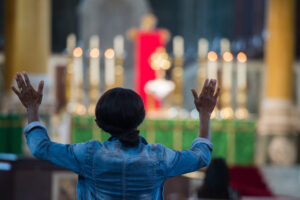
Taking the first part of this Commandment, to ‘Love the Lord your God’, the essential expression of a life lived in loving relationship with God is one of prayer.[8] This is simply ‘the raising of one’s mind and heart to God.’[9] Jesus exhorts his followers to ‘pray at all times’[10] and the Catechism reminds us that prayer ‘ought to animate us at every moment’.[11] It also reminds us that ‘the intercession of Christians recognises no boundaries.’[12] Christian prayer cannot be confined to places of worship or the privacy of one’s own home. Whilst Christian prayer is ‘anchored in liturgy’, Pope Francis reminds us that ‘it always returns into daily life…on the streets, in offices, on public transportation… and there it continues the dialogue with God.’[13] Not only is it right and good to pray for the coming of the kingdom of justice and peace, but ‘it is just as important to bring the help of prayer into humble, everyday situations.’[14] In each moment of every day, Christians are called to prayer.
Moving to the second part of this Commandment, the Church has consistently taught that charity or ‘love of neighbour’ is ‘an indispensable expression of her very being’[15], that it is a love which ’extends beyond the frontiers of the Church’[16] and that it is ‘first and foremost a responsibility for each individual member of the faithful’[17] as well as ‘a responsibility for the entire ecclesial community.’[18] It is a concern which is grounded in the love of God[19] and is a practical, not theoretical, demand on those committed to following Jesus Christ, the Lord of Life.
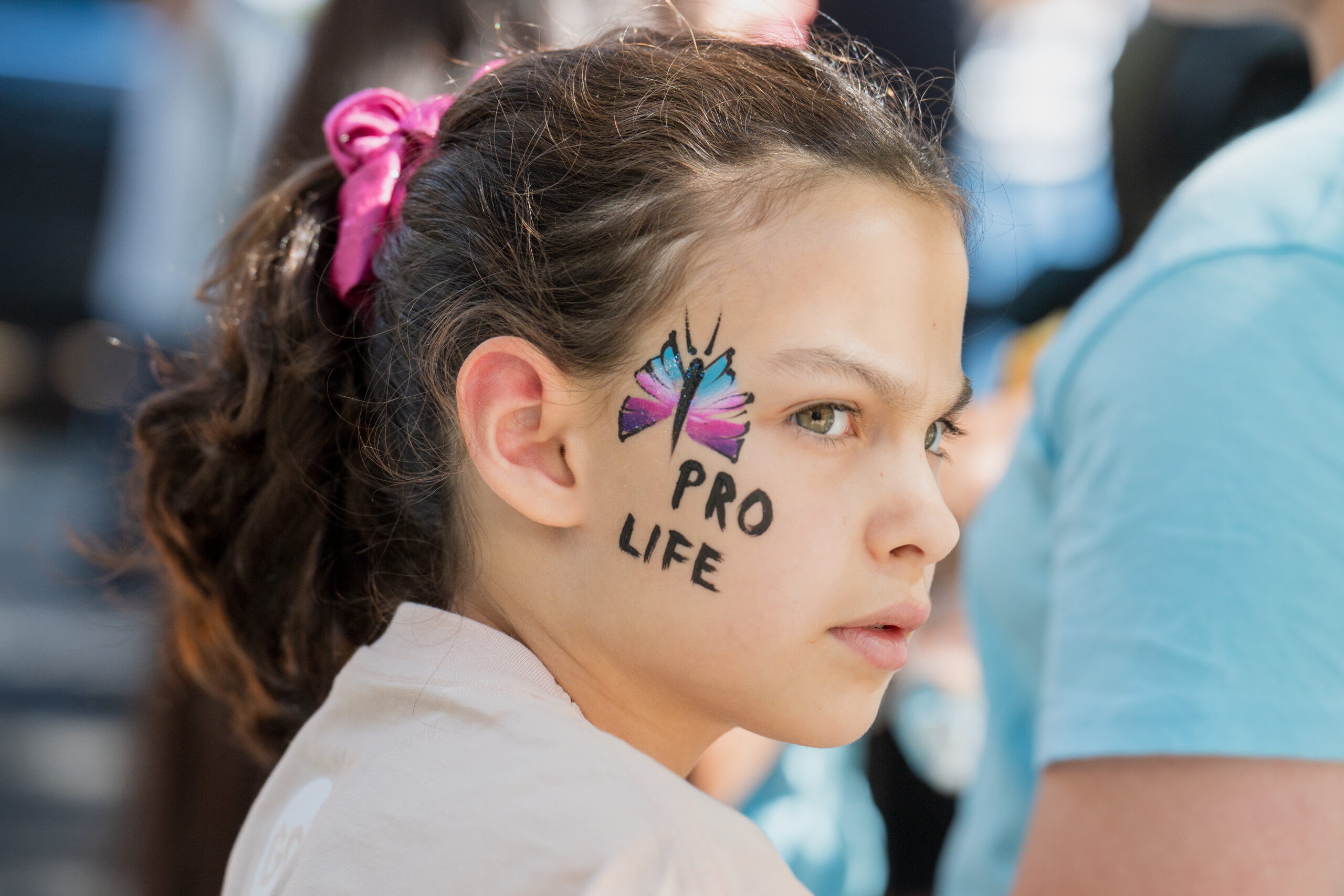
Firstly, we are called to love our neighbour with a special regard for the most vulnerable and the poorest amongst us.[20] Who can be more vulnerable than a baby in the womb? As Catholics we hold that life is sacred from the first moment of conception and that harming, attacking, or denying life in these circumstances is completely foreign to the religious and cultural way of thinking of the People of God.[21] Therefore, the defence and promotion of life, the reverencing and loving of life, is a task which God entrusts to every man and woman.[22] For decades, since the inception of the Abortion Act 1967, Catholics have been engaged in peaceful and often silent witness to the dignity of human life outside the places where over 10 million unborn lives have been taken. It is on this modern day ‘periphery’[23] that Catholics feel a strong call to witness through peaceful presence to the sanctity of life and the injustice of abortion.
Secondly, love of neighbour motivates Christians to offer practical help to those most in need. As disciples of Jesus, we are called to become neighbours to everyone,[24] especially those who are most alone and most in need. Love of Christ and love of neighbour are fundamental aspects of the Christian life and inspire and underpin all our charitable outreach as a Church. Sharing in Christ’s mission, the Church is clear that our support and promotion of human life must be accomplished through the service of charity, which finds expression in personal witness [and] various forms of volunteer work…’[25] Throughout his Pontificate, Pope Francis has exhorted Catholics to head out to the margins of society, the places of great need, desperation, crisis, isolation, misery and abandonment.[26] It is in those marginal places, that Christians are especially called to love Christ and to serve him by serving those most in need. With this in mind, Catholics in England and Wales have been long engaged in responding to this call, offering vital practical support outside abortions clinics to expectant mothers who might dearly wish to keep their babies but are often unaware of the other ‘choices’ available to them, besides abortion. Where there is need, Christ bids us to serve.
Bishop John Sherrington
Lead Bishop for Life Issues
__________
[1] Freedom of Religion is a vital human right, Bishop John Sherrington, cbcew.org.uk
[2] John Paull II, Encyclical Letter Centesimus Annus, 47, see also Address to the 34th General Assembly of the United Nations (2 October 1979)
[3] Catechism of the Catholic Church, 2559
[4] Pope Francis, Apostolic Exhortation Evangelii Gaudium, 255
[5] See Matthew 22:37
[6] Matthew 22:37 Cf Luke 10:27: ‘…and with all your strength.’
[7] Catechism of the Catholic Church 2083
[8] Catechism of the Catholic Church 2558
[9] St John Damascene, Defide orth. 3, 24: PG 94, 1089C.
[10] Luke 18:1, See also Psalm 116:2, Ephesians 6:18, Psalm 86:3
[11] Catechism of the Catholic Church 2697
[12] Catechism of the Catholic Church 2636
[13] Pope Francis General Audience of 10 February 2021: Catechesis on prayer 24. Prayer in daily life.
[14] Catechism of the Catholic Church 2660
[15] Benedict XVI Encyclical Letter Deus Caritas Est, 25(a)
[16] Ibid. 25(b)
[17] Ibid. at 20
[18] Ibid.
[19] Ibid.
[20] See Pope Francis, Apostolic Exhortation Evangelii Gaudium, 198 where he explains the Church’s ‘option for the poor’, understood as ‘special form of primacy in the exercise of Christian charity, to which the whole tradition of the Church bears witness’ and quoting Benedict XVI, he states the option ‘is implicit in our Christian faith in a God who became poor for us, so as to enrich us with his poverty.’ Cf. John Paul II, Encyclical Letter Sollicitudo Rei Socialis, 42 and Benedict XVI, Address at the Inaugural Session of the Fifth General Conference of the Latin American and Caribbean Bishops (13 May 2007)
[21] John Paul II, Encyclical Letter Evangelium Vitae, 44
[22] Ibid. 42
[23] See Pope Francis, Pre-Conclave Remarks.
[24] See Luke 10:29-37 and also Pope Francis Encyclical Letter Fratelli Tutti, Chapter 2, A Stranger on the Road.
[25] John Paul II, Encyclical Letter Evangelium Vitae, 87.
[26] See Pope Francis, Pre-Conclave Remarks.