
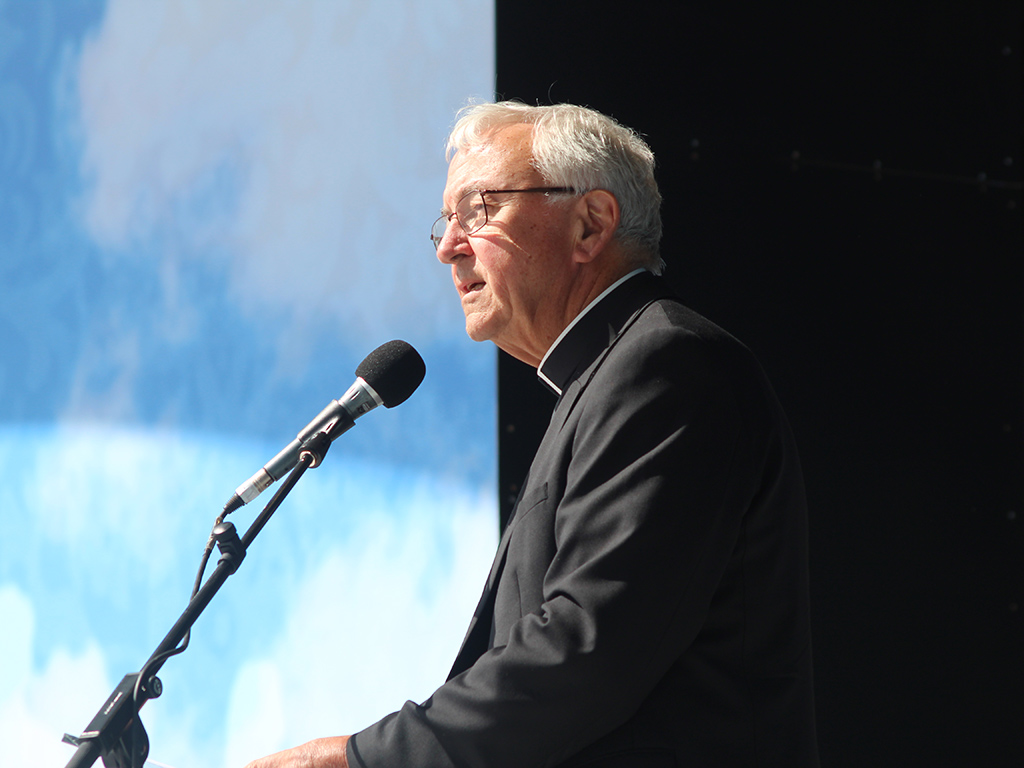
Marriage preparation is a journey, and should be approached as ‘an expression of welcome and solidarity’, said Cardinal Vincent in his keynote address at the World Meeting of Families in Dublin on 23rd August.
Unfolding the vision of the Church for married couples, he said: ‘We strive to offer a warm welcome, and a clear vision, to those who seek to be married. That vision includes our teaching about marriage, how it is rooted in the love of God and is to be an expression of the faithfulness and fruitfulness of God’s love. We have a vision of marriage being intertwined with the love Christ has for his Church, a love which includes sacrifice, forgiveness and healing. Our teaching is a rich vision that informs all that we want to share with those who are starting out on married life.’
Acknowledging that ‘marriage has become a very “private” thing’ in many places, he said that ‘Catholic families, and as the Church, we want to embrace this moment, helping couples to see the wider richness of the step they are taking, and making clear our hopes and dreams for couples in their grace-filled calling to marriage and family life’.
He went on to outline some of the characteristics of good marriage preparation, such as the role the parish can play ‘in our shared responsibility to welcome and accompany families, stressing the witness of other families, particularly for couples who come knocking at the presbytery door asking to be married’.
He stressed the importance prayer and humility: ‘we must remember that the Holy Spirit has been before us and will continue to accompany that couple in their lives.’ He emphasised that everyone ‘comes to a marriage bearing wounds, large and small from their past’ and that these and ‘many other sorrows can be soothed and transformed by this new and lasting relationship, supported by our love and prayer’.
The Cardinal also highlighted the importance of communication for ‘keeping a relationship open and healthy’, and to ‘reach the hearts of young people and appeal to their capacity for generosity, inviting them to take up the challenge of their vocation with enthusiasm, courage and heroism’.
In helping them ‘discover the vocation they are receiving from God’, he asked: ‘Can we as companions help the couple discern the deeper reasons that will keep them together in married life?’
He explained that marriage preparation seeks ‘to balance the call to love each other with the innate call to welcome the gift of children, and there is ‘a fruitfulness in both of these forms of generous love (cf AL151). What we can offer is a fuller vision, deepened through giving oneself and living for the other.’
The wedding liturgy provides another opportunity in the process of preparation, he explained. It ‘gathers together, expresses and blesses everything we believe about marriage: the commitment to a faithful, lifelong and fruitful union, utterly graced by God from beginning to end’.
‘Many couples have said that the preparation for the wedding ceremony was a powerful moment for them. We have a great opportunity here to help young couples to be alert to this experience of liturgy, to be able to touch and nourish them in years ahead. Looking again at the wedding photographs can renew those moments of grace, as well as raise a bemused smile or two!’
After the wedding, the couple’s ‘vocation is beginning and the role of pastoral accompaniment remains vital’, added the Cardinal. In practice, he explained that this might include efforts to ensure the ‘parish is intentionally welcoming’, providing moments when marriage is celebrated, teaching couples to pray together and remembering that ‘marriage preparation, in the widest sense, begins at birth!’
He emphasised that ‘there is no such thing as an “average” or even “normal” marriage. Every one is different. And all will have within them times or areas of difficulty and difference. Sources of support for couples and families are often needed.’
He concluded by speaking of fragility and brokenness: ‘Many are tempted to ask: “Can I be broken, fragile, and holy?” Yes. We may indeed carry a deep sense of failure, guilt or shame. We may judge ourselves to be unworthy. This is what we bring to the Lord, for holiness is his business. We are recipients, receivers of his mercy and therefore of his holiness. Pope Francis affirms that all of family life can be a “shepherding in mercy” (AL322), and in that way powerfully reflects the truth of our loving Father. Today, this is often our biggest challenge.’
The full text of the Cardinal's keynote address is available here.