
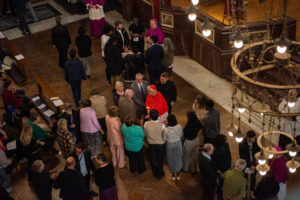
Given at the Parish of St Matthew, Northwood, on the Centenary of the laying of the foundation stone, on the Twenty-ninth Sunday in Ordinary Time, 21st October 2023
I am delighted to be with you today as we celebrate the centenary of this parish in the laying of its foundation stone. There is a year of celebrations to come! I thank everyone who has helped to prepare for this day, and all who care for the church which looks so treasured and beautiful this morning!
Today is about stones and the First Reading, from the Prophet Isaiah, mentions three stones: a foundation stone, a keystone and a ‘stone of witness’. St Paul repeats the importance of the keystone and in the Gospel Jesus speaks of the foundation stone of the Church. I would like to reflect, first of all, on the stone of witness.
Your foundation stone, just at the side by the front door, was placed there as a declaration of intent: here a church is being built. It is a stone of witness, just as this church is a witness to the presence of a community of faith and of service here in Northwood.
Now, in the Gospel Jesus is asking a critical question of his disciples. He wants to know if anyone understands who he is and the purpose he has come to fulfil. But he chooses with great care the place in which to ask that question. He takes his disciples to Caesarea Philippi.
This is a special place. First of all, there was a sizeable hill there. Deep within it there was a huge lake, the source of the River Jordan. More importantly it was held to be the birthplace of the god Pan, the god of nature. It was a place of great importance in pagan belief.
But also there was a huge temple, built of white marble, and dominating the scene. It was built by Herod the Great, the Roman ruler of Palestine, and built in honour of Caesar, who had declared himself to be a god: the Divine Emperor. Indeed, Roman emperors proclaimed that they achieved the status of god as a result of their power and greatness. The son of Herod, Philip, had enriched this temple. Hence the name of the place: Caesarea Philippi.
So here, before a great pagan god and before a temple built to earthly power, Jesus asks the question: ‘Who do you say that I am?’ And Peter gives the answer: ‘You are the Christ, the Son of the living God.’ Peter proclaims the heart of our faith: that in Jesus God is the true Godhead, not in nature – although we care for the created world – and not in earthly powers.
The same question comes to us: ‘Who do you say that I am?’ With Peter we strive to find the answer deep in our hearts, not without doubt or puzzlement, but with trusting faith: ‘Yes, you are the Christ, the Son of the living God.’ Here, in Jesus, God is present in our midst, precisely in this person, precisely here.
At the heart of our faith, then, lies not just our knowledge of Jesus, but our relationship with him, in prayer, in love and in service. It is for this that we build a church, that it may be a stone of witness to our faith in Christ Jesus.
This stone we ponder today is also a foundation stone. This is so because, in the promise of Jesus, there is a relationship between him and Peter that creates solidity, reliability in our faith. That relationship between Peter and the Lord is the ‘rock’ on which the Church has life, a relationship which is today expressed in the person of the Pope, the Bishop of Rome, who is our touchstone of fidelity to Jesus. In union with the Pope, then, we hold together in the unity of faith.
Thirdly, we can consider the keystone.
As you know the keystone is at the top of a great archway. It completes the arch and holds it all together, bearing the tension and the strains of all the weight of the upward sides of the arch. Jesus is the keystone, the only one who can hold us together as we strive to build up the service we give and the life we share, sometimes with different opinions and priorities. Building is the action of expanding the witness we give. It is faith in action.
The Second Vatican Council gave us a brief summary of the witness we are to give, the ‘building’ we are to achieve. It pointed to three things:
i) healing and uplifting the dignity of every human person;
ii) strengthening the bonds that hold people together (such as the family, a local community, through service of the common good with our talents and achievements);
iii) giving everyday activity deeper meaning and importance.
This third point, we do by our life of prayer, by our morning offering, by which we shape and dedicate to God the efforts we make that day, whatever they may be.
This reminds me of the answer to the second question of the traditional Catechism. The question is ‘Why did God make me?’ The answer: ‘To know him, love him and serve him in this world and to be happy with him forever in the next.’ That is the deeper meaning and importance we give to our everyday tasks.
A few years ago, I was walking past our church in Barnet. It was, at that time, being extended and the front was covered in scaffolding. A man passing by said to me: ‘Is the church being knocked down?’ ‘No’, I said, ‘it’s being extended.’ ‘Oh, good’, he replied. Then I asked if he went to church. ‘No’, he said, ‘but it is important that the church is there’.
May St Matthew’s long be a sign of hope for people, a stone of witness.
We thank God for this church in its hundredth year and we ask God’s blessing on its future that we all may be strengthened here to bear witness to Christ, to the compassion and hope he brings, through us, to our needy world.
Amen.
âÅ Cardinal Vincent Nichols
Archbishop of Westminster