
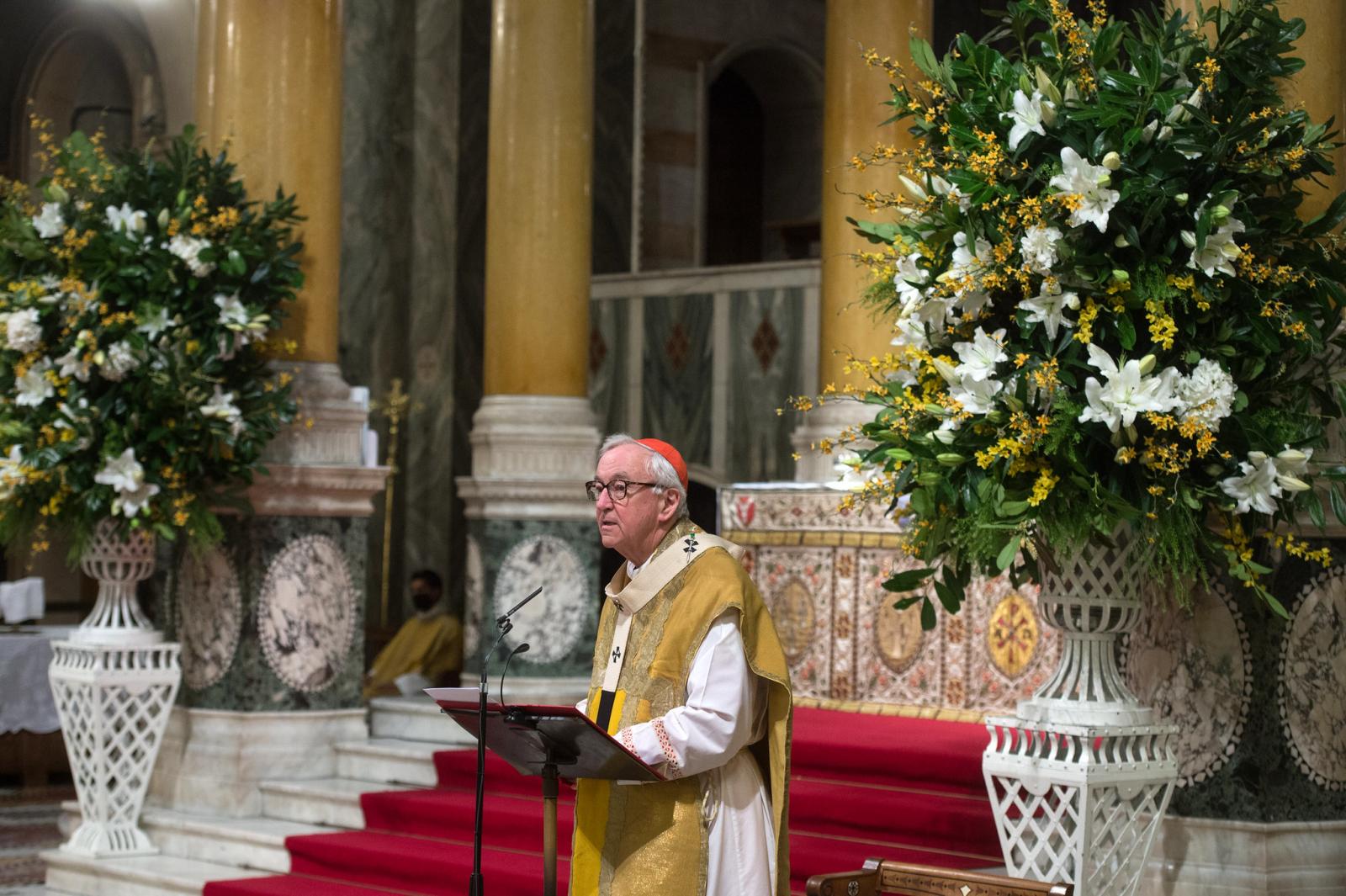
Given at Easter Sunday Mass during the Day, 4th April 2021, at Westminster Cathedral
We hear these words of the Gospel announcement of the Resurrection of Jesus proclaimed in the light of the candle which is there as the symbol of his presence.
My thoughts go out to poor old St Peter. He is running to the tomb. He is a bit bewildered. He is very quickly getting out of breath. He is being outpaced by John, the energetic John. That’s today for us. We should approach this day with a great joy, a rejoicing, with a run and a skip. Even the lambs do it, don’t they? It’s a joyful day.
I’d like to suggest that there are two words that we keep in mind today: the first is the word ‘rejoice’ and the second is the word ‘tell’.
We rejoice. We gather round this candle and all that it stands for. We know that all that darkness, that corrosion of death, that we have seen so clearly in this last year, does not have the last word. Another word is spoken, the word of love: love that is stronger than death. It’s the love of God poured out for us to lift us up. It’s the love of Jesus, responding to that love of his Father, being ready to do what is asked, to obey, and coming through in this victory.
His love is our love. Or, maybe better, our love becomes his, and we share in that victory. It’s through this victory over death that he gives us a new start, a new approach to life, a new readiness to live this daily life in a fresh way. That’s so important.
We, day by day, have to be ready for all the tasks that we face, and some of them now are going to be considerable. We have to try, after all these months of isolation and lockdown, to build back better: better in our family ties because we’ve learnt how important they are; better in our neighbourhoods because we’ve had to live locally, to appreciate the importance of the neighbourhood. We have to build back better in the way we balance work and life. Maybe we can build back better in our care for the poor and in the care for our world. The risen Lord gives us a freedom and a freshness to start again.
And our second word is the word ‘tell’. In the First Reading from the Acts of the Apostles, we see that Peter has recovered his breath. Peter is now ready to tell. We heard him addressing the people, telling the story, telling his faith. John, as he enters the tomb himself, says, ‘until this moment, we had failed really to understand’. But now on this day we can understand afresh, at least a little bit clearer. All of this, what we hear, what we receive, what we understand, is not to be kept a secret; it’s to be told. We see and we tell.
Do you remember those words? ‘Tell out my soul the greatness of the Lord.’ They’re Mary’s words and they should be ours too. So we go from here to tell, to act as a witness in what we do. I thank so many people for their courage, generosity and resilience in this last year. We’re going to tell people that we’ll pray for them. Tell them. Say, ‘would you like me to pray for you? I will.’ It’s very, very rarely that that offer is refused. Most people who maybe don’t think so much about prayer get a reminder from what you say. And in conversation, just see if we find those moments when we can speak to others of the consolation that we receive in knowing and loving our Blessed Lord.
With the joy of this Easter, let’s rejoice and let’s tell. This is his Easter day; the day the Lord has made. Let us rejoice and be glad in it. Amen.
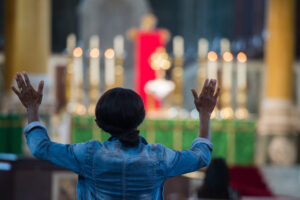
Photo: Mazur/CBCEW.org.uk