
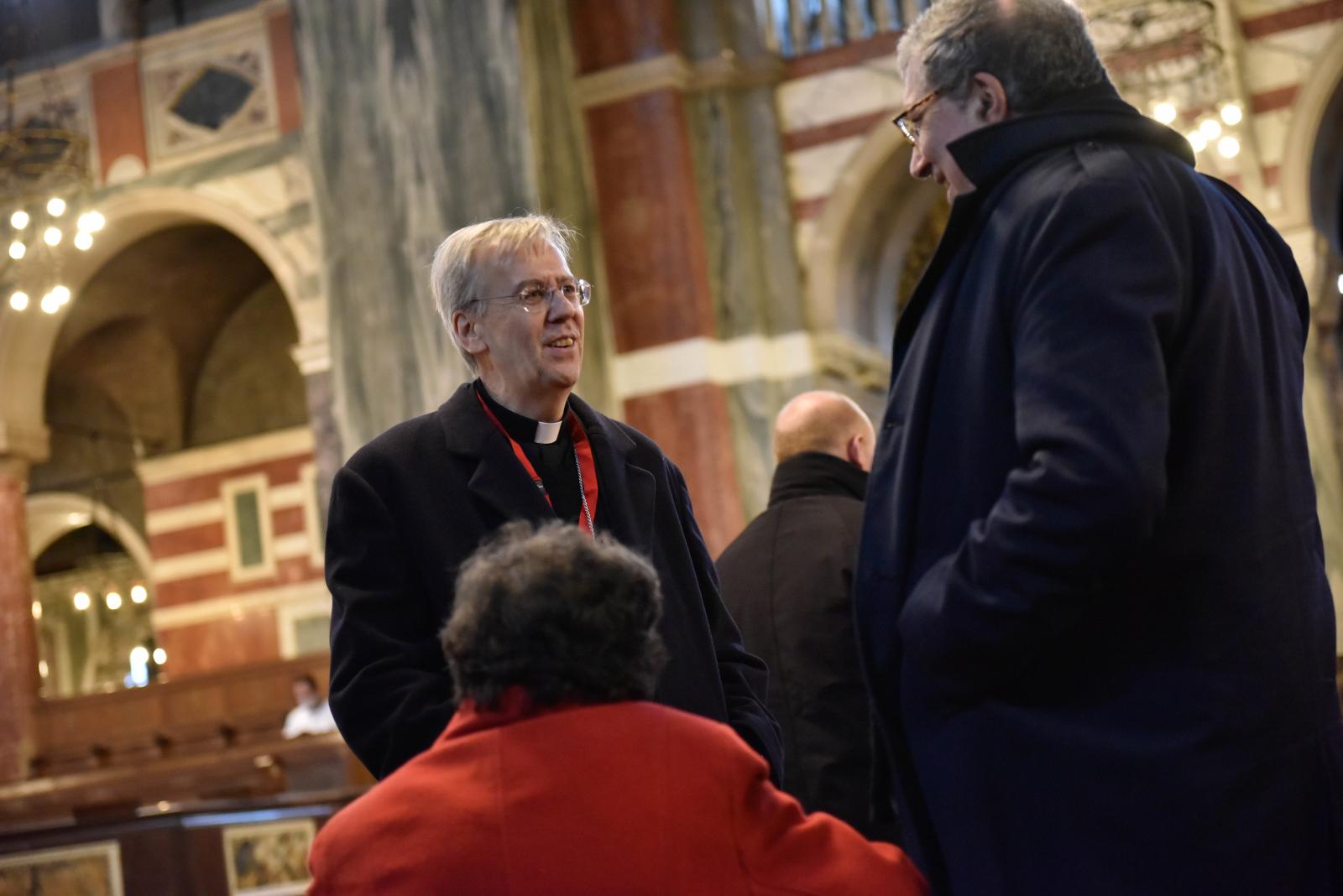
Presentation given by Bishop Nicholas Hudson to ACTA on 28th June 2023
What struck me most forcibly at our gathering for the Continental Stage in Prague was ‘the transformative power of listening’. It was a phrase used by one of the bishops in a sharing group. We were meeting for the last time; and had been invited to share a final thought about our week at the European Continental Assembly: one person expressed the hope that synodality would not be considered a magic wand but that it would become a part of who we are; another, that we had experienced a deep unity in diversity; a third, that there is a liberation to be found in sharing tensions together.
But it was the bishop’s comment which captured the most commonly heard assessment of the Assembly; that is to say, just how powerful an experience had been the listening; and how the listening had changed us. A day and half of listening to delegations from thirty-nine countries yielded a wealth of insights and observations into the Synodal Journey.
The Assembly itself was a journey. It was often said that the image which best conveyed that sense of journey had to be Luke’s account of Cleopas and the other disciple journeying with Jesus towards Jerusalem – because it captures the mutuality both of fixing one’s gaze on Christ, as they did when they sat down at table, and also of seeing with the eyes of Christ, as they did when they walked by his side and he opened their eyes to understand the meaning of all that had happened to them.
BUILDING A SYNODAL CHURCH
We’d been asked, for this Continental Stage, as national groups, to give an account of how the Document for the Continental Stage stood in relation to our own National Synthesis. The wealth of contributions is impressively captured in the Concluding Dossier (I will refer to this henceforth as ‘the Dossier’) of the Prague Assembly. There, in #20, you will see described a list of what are described as ‘Points of Reference for the Path of building a synodal Church in a European perspective.’ It’s a fascinating list, offering an exciting programme for embracing the fullness of the ‘journeying together envisaged by Pope Francis’. It calls for seven priorities:
· To forge a deeper spirituality of synodality;
· To rediscover the full meaning of our shared baptism;
· To scope out the implications of synodality for mission;
· To grow in commitment to dialogue as a way of life in the Church;
· To work to overcome prejudice and reconcile memory;
· To give preferential attention to families, women and young people;
· To adopt a synodal method for all ecclesial processes.
DISCUSSION OF SENSITIVE TOPICS
Pope Francis had said, at the outset, ‘What is under discussion at synodal gatherings are not traditional truths of Christians … It’s not about gathering opinions; this is not a survey.’ And yet we’d been charged by the Synod Office, in our parishes and diverse communities, to reflect on our experience of ‘journeying together as Church.’ That was bound to elicit views, opinions and feelings about the more sensitive topics, such as the place in the Church of remarried divorcees, the inclusion of LGBT people, women’s ordination and tensions around the liturgy. This was amply reflected in our National Synthesis, which touched on all of these.
ROLE OF WOMEN
In my address to the Prague Assembly, I noted the deep resonances between the way in which these issues were recorded in the National Synthesis and their appearance in the Document for the Continental Stage. I noted how the role of women had been a headline finding of the Synodal journey in our countries of England and Wales, as it was in the Document for the Continental Stage too. But I also noted how, in step with the Document for the Continental Stage, we heard fewer calls in the Assembly for women’s ordination than for their inclusion in the Church’s governance.
Discussion of this point in small groups yielded a recognition that, in several of our countries, large numbers of women do exercise significant leadership roles, in fact, as Trustees of Dioceses, CEOs of major charities, as Diocesan COOs, Parliamentarians, principals of educational establishments, lecturers, formators and advisers to Bishops’ Conferences. It begged the question as to whether the clericalization of such roles might not run somewhat counter to the vision of an all-ministerial Church.
INCLUSION AND TENSION
Other headline findings shared by our National Synthesis and the Document for the Continental Stage? Inclusion had been a concern expressed in the English and Welsh Synodal journey, including the inclusion of LGBT people and the inclusion of remarried divorcees in the life of the Church. What was shared in our national Synodal journey about these issues of inclusion often bore within them a certain tension, I said, in the sharing itself. By this I meant that discussion of these issues reflected what our National Synthesis described as the tension to be found in the Church needing boldly to proclaim ‘its authentic teaching while at the same time offering a witness of radical inclusion and acceptance.’ It was heartening to see that the Document for the Continental Stage echoed this English/Welsh observation, quoting it directly: the tension to be found in the Church needing boldly to proclaim ‘its authentic teaching while at the same time offering a witness of radical inclusion and acceptance.’ Heartening because it captures so much of what Synodality is about.
YOUNG PEOPLE
However, one difference I did note between our National Synthesis and the Document for the Continental Stage was in what was stated about the involvement of young people in our Synodal journey. Our National Synthesis had registered a significant engagement by our schools. The National Synthesis had further registered the contrast between, on the one hand, the joy expressed by the young people who took part in the Synodal journey and, on the other hand, the pain of those worried about young people’s diminishing involvement in the life of the Church: this tension the Document for the Continental Stage did not mention.
TENSIONS IN THE LITURGY
That having been said, I confirmed – in the liturgical sphere – that we were at one with the Document for the Continental Stage in recognising the tension between young people who seek to adhere to the 1962 Missal and those who prefer more contemporary celebrations. Nevertheless, we felt the Document for the Continental Stage did not capture sufficiently the ‘sadness and anger … sense of grievance and marginalisation’ which the National Synthesis noted on the part of many young people to exist around the liturgy.
CONCERN FOR PRIESTS
I took the opportunity to flag up, as well, that many English/Welsh priests felt they had not received sufficiently clear instructions from the Synod Office as to how they were supposed to engage with the Synodal journey. Neither the Continental Assembly nor the accompanying Dossier addressed this issue, in fact. Yet, by the same token, our National Synthesis, the Document for the Continental Stage, and participants at the Prague Assembly did all agree in their affirmation of priests and their concern that too much was asked of them.
FORMATION
I suggested that the deepest resonance came with the call for formation which pervaded both our National Synthesis and the Document for the Continental Stage; and was one of the most frequent pleas from delegates to the full Assembly. In line with our National Synthesis, I suggested we need: a formation which gives voice both to those who feel themselves to be on the margins of the Church and also to the voice of Tradition; formation in combining truth and mercy; that’s to say, a formation which holds in tension the authority of Scripture, Tradition, the Magisterium and personal experience; formation in the faith, not least the teachings of Vatican II; formation in Synodality, for clergy and laity and together; formation in listening; formation in accompaniment.
The Dossier gives testimony to how many of these topics were echoed in delegates’ submissions. The Dossier is faithful to these submissions, in highlighting families, women and young people as requiring preferential attention. The Dossier also reflects the need for formation around combining truth and mercy. Indeed, the Dossier recaptures the expression used in our own National Synthesis of ‘a Christological paradox; that is to say, the paradox of proclaiming the Church’s authentic teaching while offering radical acceptance.’
FEARS EXPRESSED
Understandably, there were cautions raised about this, which were recorded in the Dossier and expressed in the following way: in terms of ‘the risk … this may lead to a watering down of the demands of the Gospel … (that) it “could be a prelude to pastoral changes”, whereas “the Church needs to communicate Christian truth authentically and clearly”’, as the Hungary delegation put it. ‘(There is a) fear … that “considering pastoral situations related to these issues could be a prelude to doctrinal changes”’ said the Poles; ‘young people want a Church … open to … the separated and remarried, LGBT … But they also want the Church to make clear that not everything is acceptable … (and that what the Church must be about is telling) the whole truth with great love,’ observed the authors of the Dossier themselves (#55 and #56).
PLEA FOR MERCY
It was interesting to note how these cautions were answered with a concomitant recurrent plea for mercy; for truth and mercy to be held alongside each other – because ‘mercy leads to truth.’ (#59) This appeal found expression more than once in terms of a plea for us to aspire to be ‘“a Church open to all” because its eyes are fixed on Christ.’
INHABITING TENSION
This plea for truth to be tempered with mercy, and mercy with the truth, found momentum in the small-group work. Coming together in small groups, after hours and days of listening in the Plenary Assembly, participants experienced this plea very forcibly. As one participant put it, listening to different perspectives on all these issues, not just the most sensitive ones, the overriding sense was that we are called to hold all these matters in tension, creative tension. The Dossier expressed this, helpfully, in terms of ‘inhabiting this tension’. ‘Inhabiting this tension responsibly,’ it went on to say, is what will lead one into ‘greater spiritual depth.’ (#59)
CARDINAL GRECH HOMILY
The kind of depth, spiritual depth, envisaged was captured, half way through the Assembly, in a homily preached by Cardinal Grech. He chose, very strikingly, to describe the Synodal journey upon which the Church is embarked as a journey from ‘I’ to ‘you’ to ‘we’. Meaning?: meaning that true Synodal listening challenges us to move from asking where ‘I’ stand in relation to a particular issue, to listening to where ‘you’ stand, with a view to seeing where ‘we’ might stand together. So we were discovering that we aren’t required necessarily to resolve tensions: what matters is that we hold one another in that tension. The tent motif of the Document for the Continental Stage came forcibly to mind, where we are reminded that without tension the tent won’t stand, of course.
SYNODS ARE ABOUT CHANGING YOU
It was at this stage of the process that I found myself recalling what someone had said to me who had been deeply involved in the Liverpool Synod: ‘What Synods are about is changing you!’ he’d said. ‘Synods aren’t about changing the Church. What Synods are about is changing you!’ It helped me grasp all the more readily a further point which Cardinal Grech then went on helpfully to make, by way of conclusion to his homily. And it was this: that this Synodal journey should not be understood as pitting one side against another but rather about fostering the relatedness of each within the Body of Christ. The Synodal journey should not be understood as pitting one side against another but rather about fostering the relatedness of each within the Body of Christ. I thought immediately of St Paul saying, ‘Just as the ear can’t say to the eye, “I have no need of you,”’ so this process was calling us to move from saying, ‘I could do without you’ to say the reverse: ‘I can’t do without you’ – and really to mean it.
The Czech Republic delegation expressed this very eloquently, I thought, when they said that, when we consider therefore the ‘poor, the excluded, victims … of prejudice, “it is not enough to proclaim that they are welcome but that we must discover with them their place in the Church”.’ (#55) That’s to say, it’s about changing from merely accepting and welcoming difference to helping those who are different from us to find their place in the Church. Meaning? synods are about changing you!
EXISTING STRUCTURES
The question of how the Synodal journey thus advanced might change us was what we focussed on towards the end of this Assembly. I found encouraging the exchange experienced in my final small group – about the efficacy of existing structures, not least the number of councils we have in our dioceses: the Parish Pastoral Council; the Parish Finance Council; the Deanery Pastoral Council; the Deanery Clergy Council; Council of Priests; the Council of Deans; the Diocesan Finance Council; the Bishop’s Council. We were reminded of Pope Francis’s conviction that the Parish Pastoral Council is quite indispensable to the life of the Church; and his mandating it for every Parish in Rome Diocese.
DEEPER LISTENING
As I reflect on all that we experienced as we walked this journey in Prague, the phrase which best captures the experience remains for me ‘the transformative power of listening.’ It captures both the immediate legacy and what I suspect will be its enduring legacy too. By this I mean that people, laity and clergy alike, are indeed manifesting already something of a commitment to ‘the transformative power of listening’. They seem to be asking, with increasing frequency, ‘how synodal is what we are doing?’ – meaning, for instance, when they come together to make pastoral discernments, those who’ve walked this journey are now more inclined to ask: are we listening to one another; don’t we need to check to whom we should be listening; and what do we need to do to be deepening our quality of listening?
I find in this echoes of a wise challenge made to the Assembly by the Netherlands delegation, when they stated this: ‘Only when we listen to the voices that often are not heard, can we grow and discern.’ ‘Only when we listen to the voices that often are not heard, can we grow and discern.’ Allied to this is that other strand we observed earlier, of a more spiritual listening: aspiring to be ‘a Church open to all because its eyes are fixed on Christ’, as one delegation put it. Revisiting this phrase in the Dossier, about fixing our eyes on Christ, recalled for me something Cardinal Nichols said in his conclusion to the Listening Event which closed the first stage of our Synodal journey, when he gave a reflection on exactly this theme – that ‘all is found in Christ alone.’
ALL IS FOUND IN CHRIST ALONE
The Cardinal explained it in the following way: ‘Christ’s presence is crucial. His presence always remains. Without him, we are lost. We have talked about everyone being accepted. Our sense of being accepted as we are begins with him. He accepts us. Because he accepts us, then we can live. We have talked about being non-judgmental and offering forgiveness. Our experience and sense of being forgiven for what we have done is rooted in him. He, the Christ, is the source of forgiveness. We find forgiveness in him. We have spoken of our dreams for the Church. Our sense of being encouraged in what we dream starts with the words of Jesus when he issues his invitations ‘Come follow me’ or ‘Come and see’ … All is to be found in him alone.’
A CHURCH FIXED ON CHRIST
To be a Church fixed on Christ; to be listening more deeply: if these are two immediate fruits of the Synodal journey thus walked, then that is fruit indeed. To be already a more contemplative Church therefore; learning to stand side by side with all who are members of Christ’s Body, our gaze fixed on the One who calls us to be ‘ecclesia’: if that is part of what is already being experienced by those who have walked this path, then that too is rich fruit.
What it says to me is that, through deeper listening to and contemplation of Christ in one another, the Synodal journey is helping us realise that ‘being a missionary Church means … to listen as followers of Christ, to see the existential wounds of people, humanity and creation, and to act to redress them.’ That was a truth captured by the Dossier: that ‘being a missionary Church means … to listen as followers of Christ, to see the existential wounds of people, humanity and creation, and to act to redress them.’ (#29) It was striking to see the Prague Assembly waking up en masse to this truth; and finding new words to express it.