
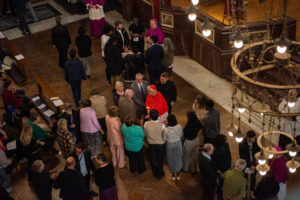
Catechesis given on 24th January 2019, at World Youth Day Panama.
I’d like to begin with a question: ‘Do you wish to change the world?’
I hope you do! I remember the excitement of being ordained. Just a few weeks before, though, on old priest said to me, ‘I suppose you want to change the world.’
And I remember thinking, ‘Yes, I’ve got to change the world. Otherwise what’s the point?’
I hope you feel the same. Because the world needs to change; it needs Christ more than ever; and it needs you – to tell people why you love and worship and wish to serve him.
To encourage you in this, I want to tell you about a man who did change the world. His name is Jean Vanier. And he’s still alive.
Jean could have done whatever he wanted in life. He was born the son of Canada’s Governor General. When he was only 15, he felt the call to leave Canada and cross the Atlantic to join the Royal Navy in England. His father told him, ‘I trust you’; blessed him; and let him go.
After 10 years of learning about warfare, Jean felt the call to study philosophy at the Sorbonne in Paris. He began to teach in Picardy, Northern France. It was while he was teaching there that a priest introduced him to people with learning disabilities. They were imprisoned in a wretched psychiatric hospital.
Jean decided to buy a house and invite two of them into his life. Their names were Raphaël and Philippe.
He called the little house ‘L’Arche’, the Ark, Noah’s Ark. Now there are L’Arche communities which welcome people with learning disabilities in 58 countries across the world. Jean says he had no idea, when he took Raphaël and Philippe into his home, that he was starting a world movement. ‘All I knew,’ he says, ‘was that I was doing something irrevocable.’
Doing something irrevocable. That’s a common feeling when we truly set out to serve the Lord. It means we know there’s no turning back, even though we don’t know where it will lead us.
Many young adults have been inspired by Jean’s example to do something similar. I have a friend called Vinciane. She worked for a long time in a fashion boutique; then for some time as a nanny. All the time, she was praying for guidance to find her true vocation. Something made her try L’Arche. There she was asked to look after one of the most disabled people I have ever met.
His name was Thadee, Thaddeus. Thadee had no movement in his limbs; and no speech. But it was sitting quietly for hours on end with him, for more than a year, that made Vinciane realise something she would never have expected: that she was a contemplative. Praying about this, she felt the call to consider life in Carmel; she entered; remained; and has been a Carmelite nun for some twenty years now. She insists it was through Thadee that she found her vocation.
There are two things we should take from these stories about Jean and Vinciane. The first is that we find our true vocation through seeking to follow. Jean’s time in the Navy wasn’t wasted time; Vinciane’s time in the boutique and as a nanny weren’t wasted time. What mattered was that they were using this time to pray for Jesus to show them where he wanted to use them to help others. Pope Francis likes to say the whole of life is a mission; and what’s important is that we keep asking the Holy Spirit to show us what he wishes us to do next, and how that fits into the mission with which he’s entrusted us.
The second thing we should take from these stories is that the poor will change us. Jean often says that, if you share your life with the poor, then they will change you. Vinciane was changed by sharing her life with Thadee: Thadee opened her heart to where the Lord was calling her to make her home, in Carmel. From her Carmel, she’s praying for each of you here today because I asked her to. Her praying for you all the way from Belgium to Panama illustrates how, in Carmel, you can be connected to the whole world through prayer.
Now, of course, L’Arche and Carmel are not the only ways to serve the Lord. Most of us are called to serve the Lord outside of such communities. What’s important is that you seek to find the place where Jesus is calling you, calling you to be his disciple. Finding our calling isn’t easy. And it matters to us profoundly because it touches on who we are at the very deepest level of our being.
It was a wise person who said, ‘Vocation is the answer to the question, “Who am I?”’
‘Vocation is the answer to the question, “Who am I?”’
‘Who am I?’ is the question which comes to us at the most critical moments of our lives. For young adults, the completion of their studies can feel like a very critical time. It’s a time when you are almost certain to be asking yourself, ‘Who am I?’; or that question which the Lord himself asked, ‘Who do people say I am?’
Wherever you are on that journey of self-discovery, it’s important you pray long and hard for the Holy Spirit to guide you that you take the right next step.
But, at the same time, you should take heart from the fact that it’s a next step: it doesn’t need to be the ultimate step.
It comes back to what Pope Francis says about mission. Remember: the whole of your life is a mission; what’s important is to ask the Holy Spirit at each step to help you make choices which are to true to the mission with which you’ve been entrusted.
It’s a mystery how some people are given clarity from a very young age; others can go through the whole of life never being really clear. One of our great English thinkers, Blessed John Henry Newman (soon to be Saint John Henry Newman) showed he understood this when he said:
‘I know God has created me to do him some definite service;
I may never know it in this life but I shall know it in the next;
he may use me simply to be a chain between different people;
he may wish to use my suffering;
however he wishes to use me, I must simply trust in him.’
Trust him. Pray deeply the prayer of trust.
There’s a great prayer of trust called the Te Deum. Te Deum? It means literally, ‘You, O God’.
It begins, ‘We praise you, O God, we acclaim you as the Lord’.
But it climaxes with the words: ‘In te speramus’; ‘In you, Lord, we put our trust’.
I was advised to pray it the night before I was ordained; and I pray it time and again, but especially when I’m struggling, when I’m in difficulty. ‘In you, Lord, we put our trust.’
Yes, the important thing is to trust; and find the grace to en-trust your life to the Lord. Do so urgently; and he will lead you where he wishes to call you.
If we’re sincere about this, then there can be no better moment to entrust ourselves than when we’ve just received Holy Communion. How can he not hear your prayer then? When he gathers us to be sacramentally present to him as he offers himself to the Father and feeds us with his Body and Blood – can there be a better moment to entrust ourselves to him? If we wish to grow in discipleship, we need to grow in love and reverence for the Eucharist.
St Teresa of Calcutta used to tell priests, ‘Pray every Mass as if it were the first Mass you ever offered.’
It’s touching how many priests have printed out those words and put them on their sacristy wall. But I would suggest there’s a message in it not just for priests but for every one of Christ’s faithful people. Pray every Mass as if it was the first Mass you ever attended. And, as you give thanks after you receive his Body and Blood, beg the Lord to guide you.
You may find it helpful to choose sayings which express your yearning; and bring them to this moment of intense communion: phrases like St Paul’s ‘When I am weak then I am strong’; the Psalmist’s ‘He guides me along the right path’; or Our Lady’s ‘Let it be done to me according to your will.’ Letting these phrases resonate within you as Jesus comes to be with you in Holy Communion, how can he not hear your prayer?
Then, as you prepare to take your leave of Mass, pause sometimes to reflect on what it must have been like for the disciples to take their leave of the place where he celebrated that very first Eucharist the night before his death. If ever you’re so blessed as to be able to visit Jerusalem, you can visit that place. It’s called the Cenacle. ‘Cenacle’? It comes from the Latin word for ‘supper’, ‘cena’; and is believed to be the site, if not the actual room, of Jesus’s Last Supper.
But just a few yards beneath it you can see the very steps that Jesus walked down to cross the Kidron Valley.
Not similar steps but the actual steps. Even if you’ve never been there, you can imagine him, in your mind’s eye, him and his disciples setting off down those steps to meet his destiny. And hear him say, ‘Come.’ Because it was ‘Come,’ he said to them. Not ‘Go’, as in ‘Go, the Mass is ended’ but ‘Come, my betrayer is at hand.’
Dwell on that ‘Come’. Because the Eucharist is an invitation not just to be with him but to go with him. There’s a phrase which captures this so well. It’s a phrase which is rooted in the Second Vatican Council. It’s the phrase: communion is for mission. It really makes so much sense of what we are about.
Communion is for mission. Because it means the communion we celebrate in the Eucharist is never to be seen as an end in itself. We don’t receive communion just in order to be in communion. We receive communion in order that we might receive strength for mission. But if communion is for mission, then mission is also for communion because when we reach out to those in need, we meet Christ in them; we experience communion with him.
So here you have another phrase to pray with as you make your thanksgiving after Communion: communion is for mission. And imagine him looking to you as he says, ‘Come’. Imagine, if you can, walking with him down those steps and across the Kidron Valley to go and be with him in his moment of greatest trial.
Giving him your heart in this way at the time of Communion will deepen your sense of communion with him; and you will most likely hear him speak to your heart telling you how he wants you to help him.
As well as offering Jesus my heart at communion, I’ve also, ever since I was a student offered him my heart at start of the day too. I started to pray, and still do, a prayer which speaks to me radically of service. I never put it up on the sacristy wall. But I did at one point tape it to my bathroom mirror so that I would learn to pray it every morning.
It’s the prayer of St Ignatius. And, if you don’t know it, you may find it as inspiring as I did; and like to begin making it part of your daily prayer too. It goes:
‘Dearest Jesus, teach me to be generous;
to serve you as you deserve;
to give and not to the count the cost;
to fight and not to heed the wounds;
to labour and to ask for no reward
save that of knowing that I do your holy will. Amen.’
The word I can’t escape in this prayer is ‘generous’. Dearest Jesus, teach me to be generous. I do believe it’s key: the key to discipleship, the key to finding our vocation. Because if we seek to be generous, then the Lord will lead us to see where he needs us to show his generosity.
I’ve found the generosity of someone like Blessed Pier Giorgio Frassati truly inspirational. To think that when he died at the age of 24 his funeral was the biggest Turin had ever seen! And the reason: all the poor of the city had turned out to line the streets.
Pier Giorgio was the kind of boy who never had any bus-money because he will have given his coins to the poor. He would always be asking you if you had any use for that piece of clothing you were casting off because he knew someone who could use it. He could have studied whatever he wished to at university, but he chose to study engineering because he wanted to help the miners: he saw that the miners of the locality suffered very abject poverty and wanted to how he could better their plight.
But his love for the poor didn’t separate him in any sense from his friends.
Google him and you’ll see countless images of him surrounded by friends, mountain-walking, skiing, invariably enjoying a drink. What his friends didn’t know was that he was continually slipping away to be with the Lord in prayer; also that he was visiting some of the poorest people in the city.
He eventually caught polio from visiting one of their homes. Even his family had no idea this was how he’d been spending all his free time. When he told his family how ill he felt, they wouldn’t believe him because he was always so positive, so well and strong. When he died, they were completely shocked to meet all the poor people of Turin coming to pay their respects and tell them how he had helped them.
Blessed Pier Giorgio is a marvellous role-model for us if we seek to be generous. He also exemplifies something deeply significant that Pope Francis says about holiness. It’s that holiness and being human are not mutually exclusive. Holiness doesn’t make you any less human, says the Holy Father.
It makes you more so. Wasn’t it St Irenaeus who said ‘the glory of God is man fully alive’? He might have added ‘fully human’. Because the glory of God is surely a man or a woman fully human and fully alive! Blessed Pier Giorgio shows us what it is to be just that, fully human, fully alive; and just how much a human being can achieve if he or she allows God’s grace to course through their veins.
This points us to the last thing Blessed Pier Giorgio teaches us. I mention it because it’s something so dear to the Holy Father’s heart. He teaches us that mercy is the key to holiness. Because it was mercy which led Blessed Pier Giorgio to return time and again, even risking his life for it, to those who were most in need. And, if we wish to know, says Jesus, on what criteria to judge our lives then mercy is the ultimate. When we saw him hungry, thirsty, sick, a stranger, imprisoned, we will be asked, ‘how did we respond?’ Blessed Pier Giorgio, even from childhood felt nothing but mercy in his heart towards those who were in need; and went to their aid.
He woke up very young to this. Others take longer. Our newest Latin American saint, St Oscar Romero, certainly took longer. It was only when he became Archbishop and began visiting the parishes of his diocese that his eyes were opened to the poverty of his people. He saw peasants fainting in the fields because they’d not been allowed to eat or drink all day. Some workers went on strike because they’d not been allowed any food or rest from sunrise to sunset. They were shot dead by the military. ‘These murderers must be hunted down,’ said the Archbishop. He received the first death-threat: ‘A bishop’s vestments are not bullet-proof,’ he was told.
The military occupied one of his churches, desecrated the Blessed Sacrament. Still he denounced their violence, going on radio time and again to speak for those who had no voice. He begged, he implored, he commanded the soldiers to lay down their arms. He received a second warning, this time formal.
‘I am afraid,’ he told his friends, ‘but I trust. I trust that, if they kill me, then, as I take my last breath, I shall feel God holding me in his loving embrace.’
And so it happened. A few days later, as he was celebrating Mass in a hospital chapel, he ended the homily; and then he saw what only he could see because everyone was facing the front; only he could see what was happening at the back. The door opened; a lone marksman raised his rifle to the shoulder and shot the Archbishop in the chest. Five minutes later, he had bled to death. Two days later, San Salvador saw the biggest funeral it had ever witnessed.
Just four months ago, Pope Francis declared the saintly Archbishop ‘Saint Oscar Romero’.
Two great lives, two quite different ages: Frassati 24, Romero 62. Vanier still giving of himself, now 90. Each, in their own way, shining lights of generosity.
Three servants of the Lord and of his kingdom: Each having achieved an extraordinary mission, such that their light will shine forever both on earth as well as in heaven.
By their mission they teach us that our own life is a mission too. We may discover that mission sooner; we may discover it later; it may never be that clear to us. What matters is that, at every important stage of life, we entrust, re-entrust ourselves to him; and he will lead us to do great things for him, as St Teresa of Calcutta used to say, to ‘do something beautiful for God – to do something truly beautiful for God.