
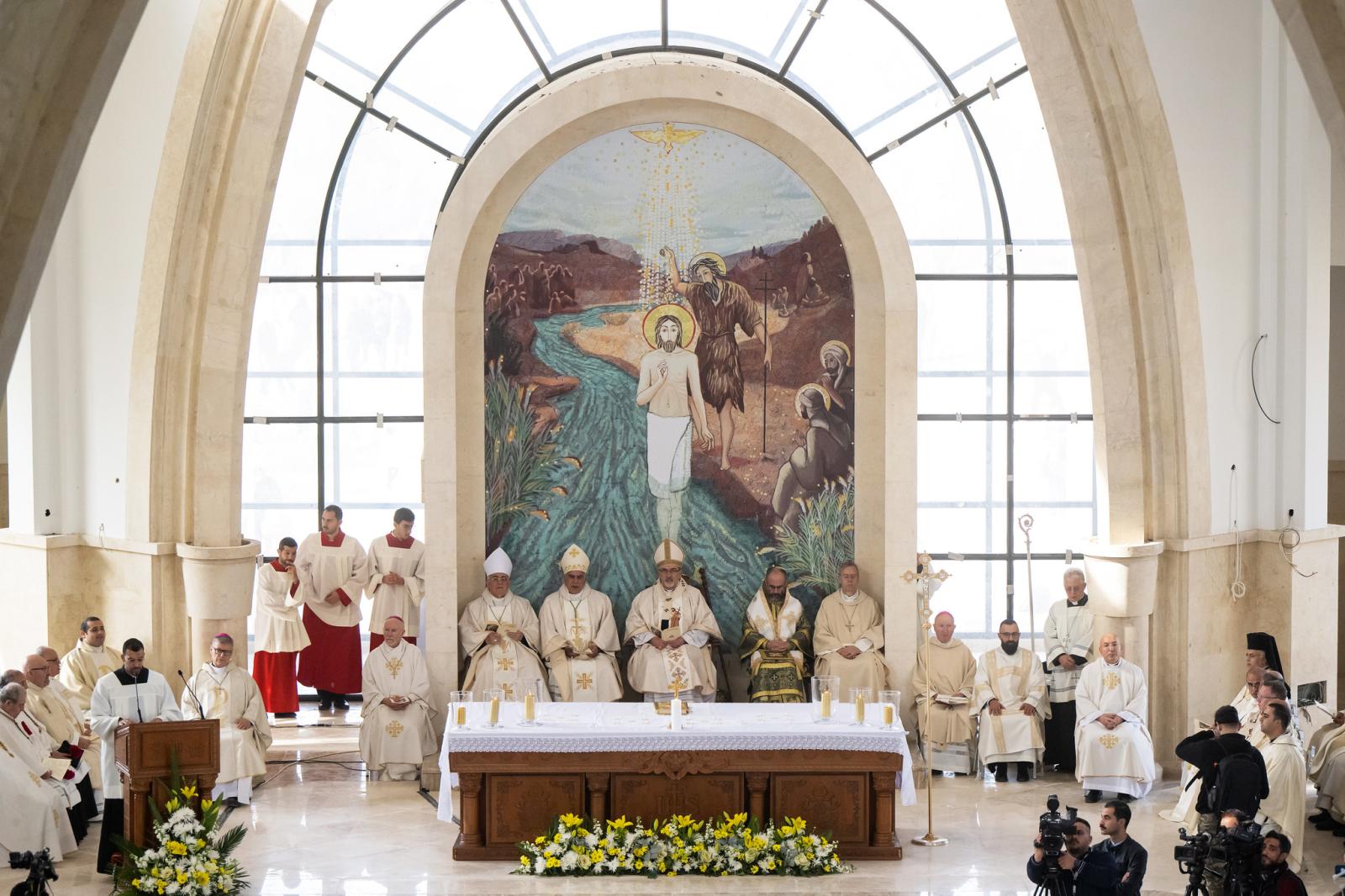
Given at the site of the Baptism of the Lord on the banks of the Jordan on 17th January 2023, during the Holy Land Co-ordination visit
It is wonderful to be together on the banks of the River Jordan. To think of the hordes that gathered here when they heard that John was baptising! The whole of Judea and all the people of Jerusalem, Mark tells us, were here!
It’s not that ritual washing was a novelty. John himself is thought probably to have come from the Essene community in Qumran, not so very far from here. I learnt that from Pope Benedict’s Infancy Narratives; and I shall draw much of what I say here from that beautiful volume. The Essenes had regular liturgical ablutions. But what was different about this ablution, of course, was that it was unrepeatable. It involved a once-and-for-all confession of sins; repentance; and conversion to a new way of life.
It helps if we appreciate just what this river symbolised to the people who came from far and wide to queue for this once-in-a-lifetime washing. To the ancient mind, a river like the Jordan would have symbolised both life and death. The ancient mind perceived oceans as a permanent threat to the earth. And a river like the Jordan could easily assume this same symbolic value. But, at the same time, the River Jordan was clearly a rich source of life for the whole of the Fertile Crescent. So immersion into it contained both these elements: both life and death, both a dying and a rebirth. This is beautifully captured in the iconography of the Eastern churches. The classical icon of Jesus’s Baptism in the river Jordan depicts the water he enters as a liquid tomb; and the tomb has the form of a dark cavern: clearly an image of the death he enters in order to emerge living again from these waters.
This brings us to the central drama of Jesus’s appearing on these banks. John’s question is our question: how can you choose to go down into the same waters as the rest of us when you have no sin to confess and no change of life required? The answer, Pope Benedict tells us, is to be found in that word ‘righteousness’. 'Do all that righteousness demands,' says Jesus. Because righteousness is saying ‘yes’, a profound ‘yes’, to the will of God. To John and Jesus and the people of their world, ‘righteousness’ was man’s answer to the Torah, the full acceptance of God’s will. More: it signified the taking up of the yoke of God’s kingdom. By choosing to make such an act of pure righteousness, Jesus is expressing not his sin but his acceptance of God’s will.
He is also showing solidarity. Ah yes, we all find ourselves thinking; that’s how I’ve always understood Jesus’s baptism: a profound act of solidarity with his fellow man and woman. But this word ‘righteousness’ helps us understand it’s more than just solidarity. It’s a taking on of their sin. Because all those who queue to enter the water have incurred guilt; and so yearn for righteousness. Jesus is the one who has no guilt and yet chooses to come alongside them in their yearning for righteousness. So we see the profound truth in the observation of Pope Benedict’s: that Jesus chooses to inaugurate his ministry by stepping into a place of sinners.
And, as he steps into the waters, he prays. Because he is loading onto his shoulders the burden of man’s guilt; and bears it down into this river. We, like his first followers, can only grasp the fullness of this in the light of his dying and rising at Easter. But the point is that he inaugurates his ministry by anticipating the cross here and now. John’s calling him the ‘Lamb of God’ explicitises this for us: we realise that the Lamb who enters these waters is, of the course, the true Paschal Lamb. Something I didn’t know is that the word John uses for ‘lamb’ – ‘taka’ in Hebrew – can also mean a ‘boy’, a ‘servant-boy’. So we see that we are encouraged to understand that the Lamb who enters these waters is indeed the Suffering Servant who heralds our celebration of the Good Friday liturgy.
And a voice speaks from heaven, saying, 'This is my Son, the beloved'. For this the heavens open; the heavens open! The goal of righteousness is anticipated here in the Baptism. What’s more, a dove is seen to descend. Meaning: here in this place is present the Triune God, here on the first day of the Son’s public ministry. And an arc is suggested, a wonderful arc, between the inauguration of Jesus’s ministry and the start of ours: when Jesus tells his disciples after his Resurrection not simply to go and make disciples but to baptise them in the name of the Triune God.
It means that this is truly the place where our mission began, as bishops, priests, lay men and women. It’s where our mission was given to us. That why it’s such holy ground for us.
Bishop Nicholas Hudson
Photo: Mazur/CBCEW.org.uk