

Given on the Feast of St Philip Neri, 26th May 2023, at the London Oratory School
St John Henry Newman in The Idea of a University writes of St Philip, ‘And who was he, I say, all the while, but a humble priest, a stranger in Rome, with no distinction of family or letters, no claim to station or to office, great simply in the attraction with which a Divine Power had gifted him? And yet, thus humble, thus ennobled, thus empty handed, he has achieved the title of Apostle of Rome.’
These words emphasise that the work of becoming a Saint is a grace and gift of God. God so captured St Philip’s heart that Holy Spirit burned within him to deepen this love and then, following Jesus’ commandment, to share it with others. St Philip’s character was attractive, persuasive, and influenced those who met him very powerfully. Like a magnet he attracted others to Christ.
Jesus summons us in the words of the gospel we have just heard, ‘As the Father has loved me, so have I loved you; abide in my love.’ What does it mean to abide in his love; firstly, like St Philip to pray, then to live the commandment of love towards others. St Philip learnt to pray in the Dominican monastery of San Marco in Florence, the home of the fifteenth century friars Fra’ Girolamo Savonarola and the wonderful fresco painter Fra’ Angelico, both who influenced him. Here St Philip received his first religious instruction, and later used to say, ‘Whatever there was of good in me, when I was young, I owed it to the Fathers of St Mark's, in Florence.’ We all depend on our teachers to help us learn and we pray for them today. In this monastery he was surrounded by the simplicity but profound beauty of Fra’ Angelico’s frescos. The Annunciation is well-known to many people. I am sure that the delicate beauty of these frescos touched his heart and were a foundation for his future faith. Art engages, attracts, and stimulates the imagination. As St John Paul wrote in his Letter to Artists (1999), ‘Beauty is a key to the mystery and a call to transcendence. It is an invitation to savour life and to dream of the future. That is why the beauty of created things can never fully satisfy. It stirs that hidden nostalgia for God…’
Later at the age of 18, St Philip left Florence and deepened his prayer in the rugged and harsh caves of Monte Cassino, the home of St Benedict. Here the ‘book of nature and the book of grace’ (St John Henry Newman) were his teachers. Two years later in Rome he found his home for prayer in the ancient basilicas, the cemeteries, and the catacombs of the saints of the Early Church who endured hidden life, persecution and martyrdom. Later he was influenced by St Ignatius who was living in Rome and helped him to understand the call to live in the world but not be of the world. St Philip and St Ignatius strengthened many of the young seminarians at the nearby English College to stand firm in their Catholic faith and to be courageous if necessary to die as martyrs on return to England. He learnt to abide in Christ, to pray and discover the joy of his faith. In the words of one of the few personal prayers which have handed down to us, Jesus is the teacher,
I fain would love Thee my Jesus, but I do not know how.
I shall never love Thee if Thou dost not help me, my Jesus.
I would fain find Thee, my Jesus, and I do not know the way.
We each need saints who are our friends in heaven. I grew up in the parish of St Thomas More and so always remember the statue above the church door with the inscription ‘The King’s Good Servant, but God’s First’. At confirmation I took the name St Joseph who is the protector of the Church. In Lourdes I learnt the simplicity of St Bernadette. At university I discovered the courage of St (then bishop) Oscar Romero and his passion for justice. They shaped me, who shapes you?
Jesus’ commandment ‘love one another as I have loved you’ echoed in his heart and determined when he got out of bed to pray, how often he committed himself avidly to reading, how he interacted with people and how he lived each day in the service of Jesus Christ. St Philip knew that he was a friend of Jesus, not merely a servant. He was compelled to love others whom he met, to care for the sick and those convalescing from hospital, to provide hospitality to pilgrims in Rome, to bring people into the Church and teach them to pray, to inspire musicians, and later as a priest to spend hours upon hours in the confessional bestowing the gift of God’s mercy upon sinners. For forty-five years as a priest, he heard the confessions of the rich and the poor, the young and the old, the dissolute and the humble; all of whom remembered those words of love and freedom, ‘Et ego te absólvo a peccátis tuis, in nómine Patris, et Fílii, et Spíritus Sancti. Amen.’ The saints and the sinners of Rome knew instinctively that St Philip was a holy man and wanted to be with him and learn from him.
One of the nine fruits of the Holy Spirit is joy. St Philip exuded this joy in his life. He encouraged others to rejoice in the Lord always and not to be afraid because Jesus has conquered the world.
May you all be joyful in the Lord and enjoy this Feast. Thanks be to God.
St Philip, pray for us.
Bishop John Sherrington
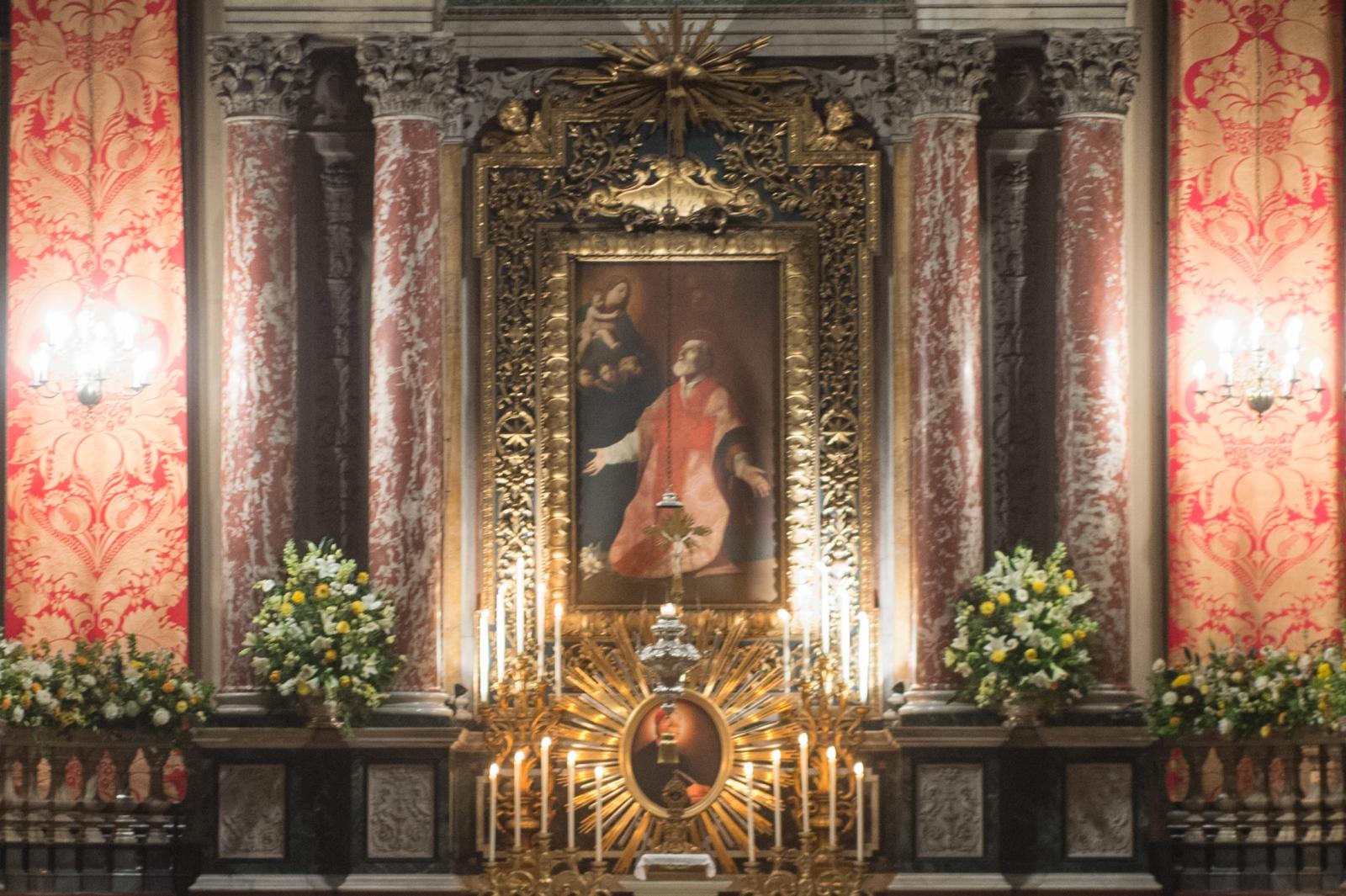
Photo: Portrait of St Philip Neri in Immaculate Heart of Mary (Oratory) Church in London (Mazur/CBCEW.org.uk)