
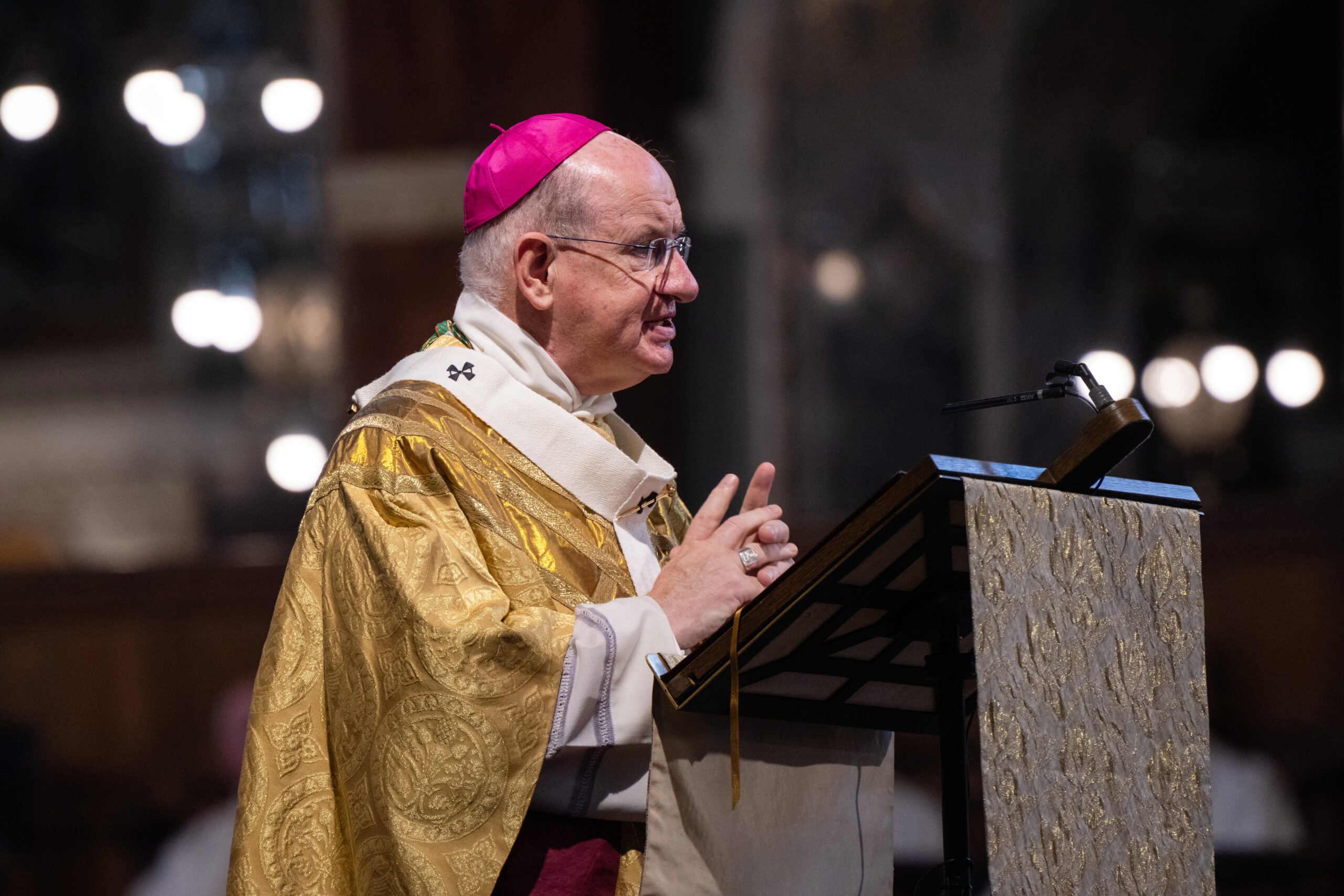
Given at Westminster Cathedral on 1 November 2026.
Dear brothers and sisters,
Yesterday evening, I encountered numbers of young people, some of them accompanied by their parents, marking what has come to be known as Halloween. The dressing up, the fun and games, is a modern and secular take on All Hallows Eve – the eve of All Saints. Today, we celebrate the Saints – the “great multitude than no one could number, from every nation, from all tribes and peoples and languages, standing before the throne and before the lamb.”[1]
Every one of us is called to be a saint! Throughout our history as followers, disciples of Christ, we have the examples of the saints who have been canonised, the examples of the beati – the blessed ones – whom the Church also recognises, the servants of God, whose journey towards canonisation has begun. We celebrate, too, that countless number – our loved ones amongst them – who enjoy the wonder of Heaven.
I am sure that everyone in this Cathedral today will have a devotion to a particular saint and our Cathedral is adorned with images of a great many of them. Here in the Sanctuary, the images of St. Stephen, St. Lawrence, St. Therese of Lisieux and St. John Vianney and – of course – Our Blessed Mother, whose image adorns the reverse side of the crucifix, the great rood, above us.
How, we ask ourselves, can I be a Therese of Lisieux, a Curé of Ars, a Carlo Acutis? The answer does not lie here. As a Carthusian monk friend of mine once wrote: “The essential of the saints is the divine spark of grace in a saint’s soul, that something of God’s Spirit that is freely given and freely received.”[2]
God our loving Father seeks always to give us His love. We see this in the life of His beloved Son, who Gives Himself totally, to the very last drop of blood, on the Cross and who continues to give us Himself in the wonder of the Eucharist. The gentle voice of the Holy Spirit is ever present, calling us to be disciples and enabling us to fulfil the Father’s design for us.
The gift is free – it is not always freely received. We so often stifle that divine spark of grace in our soul, we fail to notice it, we allow the distractions of the world around us – even the legitimate responsibilities of our lives – to take us away from this spark of grace. Perhaps we even try to bargain with God, rather than simple receive in freedom. This, surely, is the mark of the saint – the free reception of God’s divine gift and then the living out of that gift with total commitment and total freedom.
There is something transparent about the saint. When we reflect on their lives, we see the love of God, shining though their words and actions, their work and their witness. We see that divine spark, shining in such simplicity that God’s love shines with the most intense brightness. All is done for the greater glory of God.
Today’s Gospel of the Beatitudes offers us the way of this blessedness, spelt out for our daily lives: poverty of spirit, purity of heart, the simplicity of meekness, the experience of mourning, the thirst for righteousness and the work of making peace, the lived experience of mourning, the acceptance of hardship and persecution. These, too, are gifts and our free reception and living of these ways of blessedness bring that spark of divine grace to the world around us.
I – we – are not called to be St. Therese of Lisieux, the Curé of Ars, St. Carlo Acutis. “The example of the saints encourages us to something of the same quality of commitment but embodied according the particular grace of each one.”[3]
We are God’s creation. Each of us is an ‘original’ – each of us has the particular gifts, particular graces that God gives to us. The first step to sanctity is the welcoming of these gifts and graces, the particular expression of that divine spark that is particular to each one of us. Allowing that spark of grace to shine without hindrance on our part is the way to discipleship, to life lived in the way of the beatitudes, to a life lived in the fulfilment that is life guided by the Holy Spirit. It is the way to sanctity – to a life that shines with the life and love of God, in whom is all beatitude, all glory.
[1] Rev. 7:9.
[2] A CARTHUSIAN, The Spirit of Place – Carthusian Reflection, London, DLT, 1998, p. 80.
[3] op.cit., p.81.