

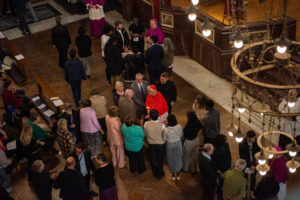
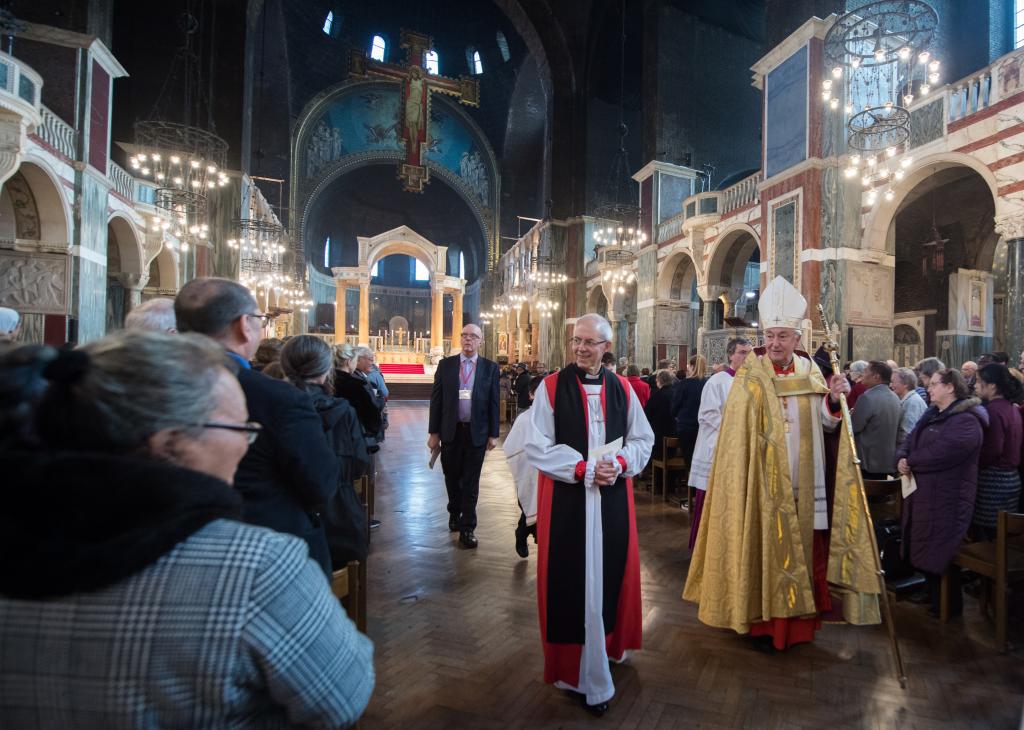
On Saturday 19th October 2019, Cardinal Vincent Nichols welcomed Justin Welby, the Archbishop of Canterbury, to Westminster Cathedral for Solemn Vespers. The ecumenical service was held in celebration of the canonisation of St John Henry Newman. Cardinal Vincent presided, with Archbishop Justin Welby delivering the sermon.
In his written message of welcome in the Order of Service, Cardinal Vincent extended a particularly warm welcome to the Archbishop of Canterbury: ‘His presence is a sign of the deep bond between our Churches and of the ways in which, in our new Saint, we find such encouragement for our common life in Christ and our shared exploration for faithfulness to his gospel and teaching. His presence is also, for me, a cherished sign of our personal friendship.’
In his message of welcome, Cardinal Vincent also highlighted the ‘shared joy’ of both the Catholic Church and the Church of England at the canonisation of St John Henry Newman, a saint who lived out his ‘pastoral mission’ in both.
‘His life was also characterised by a constant pastoral ministry, from his early days as a young priest of the Church of England to the last of his many years of Catholic priesthood in Birmingham. There he made his ministry to the poor and to the sick a daily priority. In this, too, he is an inspiration for us today.’
In his sermon, the Archbishop of Canterbury acknowledged both the privilege and the apprehension he felt at speaking about St John Henry Newman, a man who left the Church of England and converted to Catholicism. Justin Welby also pointed out that it is wrong to present the two Christian traditions as rivals: ‘For we are not enemies, nor are we opponents, nor even rivals. God forbid! Indeed, God has forbidden. We are more like a family that had a very bitter dispute, a divorce in the past, and has acquired the habits and occasionally bad manners of separation. For all that we are still family, called together by grace, caught up in the love of God.’
Speaking about the life and example of St John Henry Newman, the Archbishop of Canterbury argued that, although ‘it is easy to find faults in St John Henry’, the new saint ‘stands as a model of the purposeful disciple.’
‘We may disagree with his actions, but we know their origins – he pretends to little – and we see their structures. As the old Maths exam papers say, “show your workings” and he did.’
‘The care for salvation, the passion for truth, the desire for holiness, are apparent and more apparent than the weaknesses. If we want perfection in saints, give up. There are no perfect saints, but we have as witnesses to our struggles the great crowd of witnesses who are sanctified not by their own efforts, but by a particular openness to grace, an unusual, utterly entrancing willingness to be the person whom God is calling.’
The opening hymn, ‘Firmly I believe and truly’ and the recessional hymn, ‘Praise to the Holiest in the height’, both featured the words of St John Henry Newman’s poem, ‘The Dream of Gerontius’.
Photos from the Ecumenical Solemn Vespers are available here.
Published: 21st October 2019