
The Catholic Bishops’ Conference of England and Wales have set out a vision for the renewal of Church and society through the mission, teaching and witness of all the Christian faithful.
On this anniversary of the momentous Visit of His Holiness Pope Benedict XVI to the United Kingdom, we recall the excitement, vision and hope that stirred in the hearts of so many who watched or took part in those historic events. Many experienced the Visit as a powerful encounter of God’s love and a welcome response to the “deep thirst there is among the British people for the Good News of Jesus Christ”.
Only a few days after returning to Rome from the UK, the Holy Father spoke movingly of the importance of the Visit:
“It was an official Visit and at the same time a Pilgrimage to the heart of the past and of the present of a people rich in culture and faith, as is the British people. It was an historic event that marked a new and important phase in the long and complex relations between those peoples and the Holy See….in the four busy and very beautiful days I spent in this noble land I had the great joy of speaking to the hearts of the inhabitants of the United Kingdom and they spoke to mine, especially with their presence and with the testimony of their faith. Indeed I could see how strong the Christian heritage still is and how active it still is in social life at every level. British hearts and British lives are open to the reality of God and there are numerous expressions of religious feeling that my Visit has made even more visible.”
A vision for the church in our land
Mindful of the need to “proclaim the Gospel afresh”, Pope Benedict presented a vision and direction for the Church in our land. This vision challenges each Christian believer, “in accordance with his or her state of life”, to work “for the advancement of God’s Kingdom by imbuing temporal life with the values of the Gospel”. Inspired by the teaching of Blessed John Henry Newman, it directs the Church on a journey where, “each of us has a mission, each of us is called to change the world, to work for a culture of life, a culture forged by love and respect for the dignity of each human person”. All of this, the Holy Father reminded us, can only be attained “By letting the light of faith shine in our hearts, and by abiding in that light through our daily union with the Lord in prayer and participation in the life-giving sacraments of the Church”.
What this vision encourages us to seek and hope for is the renewal of Church and society through the mission, teaching and witness of all the Christian faithful. Pope Benedict has helped many to see that faith in God is not a problem to be solved but a gift to be discovered afresh. By his gentle, courteous, humble and open-hearted approach, the Holy Father models for us a way in which we can share this vision with others. By our gentle, courteous, humble and open-hearted living of the Christian faith, we too can proclaim the Gospel through the “beauty of holiness”, “the splendour of truth” and “the joy and freedom born of a living relationship with Christ”.
In setting out this vision, the Holy Father also reminded us that we must be realistic in our understanding of contemporary society and the world around us. The financial crisis which Pope Benedict spoke of a year ago and the suffering of long term unemployment which has caused so much hardship to countless individuals and families, is still very much with us and its end seems a long way off. The effects of the global economic emergency, the desperate living conditions which millions of people face all over the world, the lack of hope and the profound crisis of faith within our society, form the context in which this vision is presented. Nevertheless, Pope Benedict reminded us that it is precisely in times of “crisis and upheaval” that “God has raised up great saints and prophets for the renewal of the Church and Christian society”. All the Christian faithful should then reflect on and, seek the graces for, the particular “definite service” that Almighty God is calling us to give.
The New Evangelisation
A significant part of our continuing reflection on the Holy Father’s Visit and the vision he presented to us will involve next year’s XIII Ordinary General Assembly of the Synod of Bishops in Rome. This Synod will have as its theme: ‘The New Evangelisation for the Transmission of the Christian Faith’.
After his Visit to the UK, Pope Benedict explained that: “In addressing the citizens of… (the United Kingdom), a crossroads of culture and of the world economy, I kept in mind the entire West, conversing with the intellect of this civilization and communicating the unfading newness of the Gospel in which it is steeped. This Apostolic Journey strengthened a deep conviction within me: the ancient nations of Europe have a Christian soul, which is one with the ‘genius’ and history of the respective peoples, and the Church never stops working to keep this spiritual and cultural tradition ceaselessly alive.”
That statement links the urgency of the New Evangelisation with the vision and challenge presented by the Holy Father during his Visit. The Christian faith has ancient and deep roots in our lands. It has formed our nation and continues to play an important role in forming many aspects of our national and cultural life. It has a voice and a resonance which find a home in many a heart of those within our land who would not necessarily call themselves Christian.
Yet, as Pope Benedict stated: “No-one who looks realistically at our world today could think that Christians can afford to go on with business as usual, ignoring the profound crisis of faith which has overtaken society, or simply trusting that the patrimony of values handed down by the Christian centuries will continue to inspire and shape the future of our society.”
The challenge of the New Evangelisation is then, ‘how’ we “work for the advancement of God’s Kingdom by imbuing temporal life with the values of the Gospel” and “present in all its fullness the life giving message of the Gospel”.
The work ahead
Over the past year, we the Bishops of England and Wales have reflected together on the Holy Father’s “pilgrimage to the heart of the British people” and the vision he presented. We have considered the challenge he issued to the Church, to proclaim the Gospel, “which liberates our minds and enlightens our efforts to live wisely and well, both as individuals and as members of society”. Together with the Church throughout the world, we are determining the demands of the New Evangelisation.
We have begun to formulate how the mission, teaching and witness that we must give will be expressed strategically in the priorities, aims and objectives for our work as a Bishops’ Conference over the next three to five years. These priorities will shape our work as a Bishops’ Conference, determining our use of scarce resources and offered in support of the mission of every diocese in England and Wales.
Integral to this work is recognising the importance of being confident, faithful and courageous in our mission, teaching and witness. Following the wonderful example Pope Benedict has given us, in our mission we must be gentle but also confident in manifesting the ‘beauty of holiness’, a beauty which can lead the heart of every person to an intimate knowledge of Christ. In our teaching, we must be courteous but also faithful in proclaiming the ‘splendour of truth’ through “the witness of lives lived in integrity, fidelity and holiness”. In our witness, we must be humble and open-hearted but also courageous in testifying to ‘the joy and freedom born of a living relationship with Christ’.
In respect of our mission, our first priority area of work will be: ‘To proclaim the universal call to holiness in Christ – by promoting a culture of vocation within the corporate identity of the Catholic Church, marked by a confident Catholic faith’; in relation to ‘teaching’, the second priority area of work will be: ‘To proclaim Christ and his Gospel as saving truth – by fostering and encouraging a culture of dialogue and solidarity’; and in terms of witness, our third priority area of work will be: ‘To proclaim the coming of the Kingdom of God – by serving and witnessing to the whole community, especially by supporting marginalised and vulnerable people’.
Within these priority areas we have already identified a number of aims and objectives:
We have re-established Friday abstinence as a common act of witness and of solidarity with those who are in need or suffer and as an expression of our vocation to follow Christ who sacrificed his life for the good of all humanity.
We are actively encouraging lay Catholics to witness publicly to their faith with renewed confidence and to communicate a culture of vocation to a wide audience.
We are creating a national vocations framework, offering discernment opportunities to all, not only to ecclesial vocations but also to marriage and other forms of lay witness.
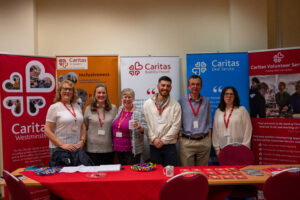
We will continue to encourage the programme we have begun of ‘deepening social engagement’ to bring greater coherence, support and visibility to the Church’s evangelising witness through the development of ‘Caritas’ within England and Wales.
We will foster opportunities to “build bridges of friendship to other religions, to heal past wrongs and to foster trust between individuals and communities” by building on the unique and inspirational encounter between people of faith and representatives of other religions which took place during the Holy Father’s Visit.
We will work with other Christians and people of other religions to identify the areas of greatest need, at home and abroad, so that we can come “together in concrete forms of collaboration, as we apply our religious insights to the task of promoting integral human development, working for peace, justice and the stewardship of creation” and to work “together for the good of the community at large”.
We will strengthen our communication of the work of the Church through the use of new technology and build partnerships with appropriate media outlets to build on the vision of the New Evangelisation for the transmission of the Christian Faith.
Confidently Catholic
In coming to the UK, the Holy Father “…wanted first and foremost to support the Catholic Community, encouraging it to work strenuously to defend the immutable moral truths which, taken up, illuminated and strengthened by the Gospel are at the root of a truly human, just and free society.” He also wished “…to speak to the hearts of all the inhabitants of the United Kingdom, excluding no one, of the true reality of man, of his deepest needs, of his ultimate destiny.”
We believe that the ‘beauty of holiness’, the ‘splendour of truth’ and the ‘joy and freedom born of a living relationship with Christ’ can still speak powerfully to the hearts of the people of our country. This is the inspiration for our work ahead.
On this Home Mission Sunday, the anniversary of the Holy Father’s visit to our country, we renew our faith in the power of God to lead us all through the difficult times faced by our nation and by our world. Confidently Catholic, we look forward then not anxiously or fearfully but with renewed hope and courage. We invoke God’s blessing on our country and on our world