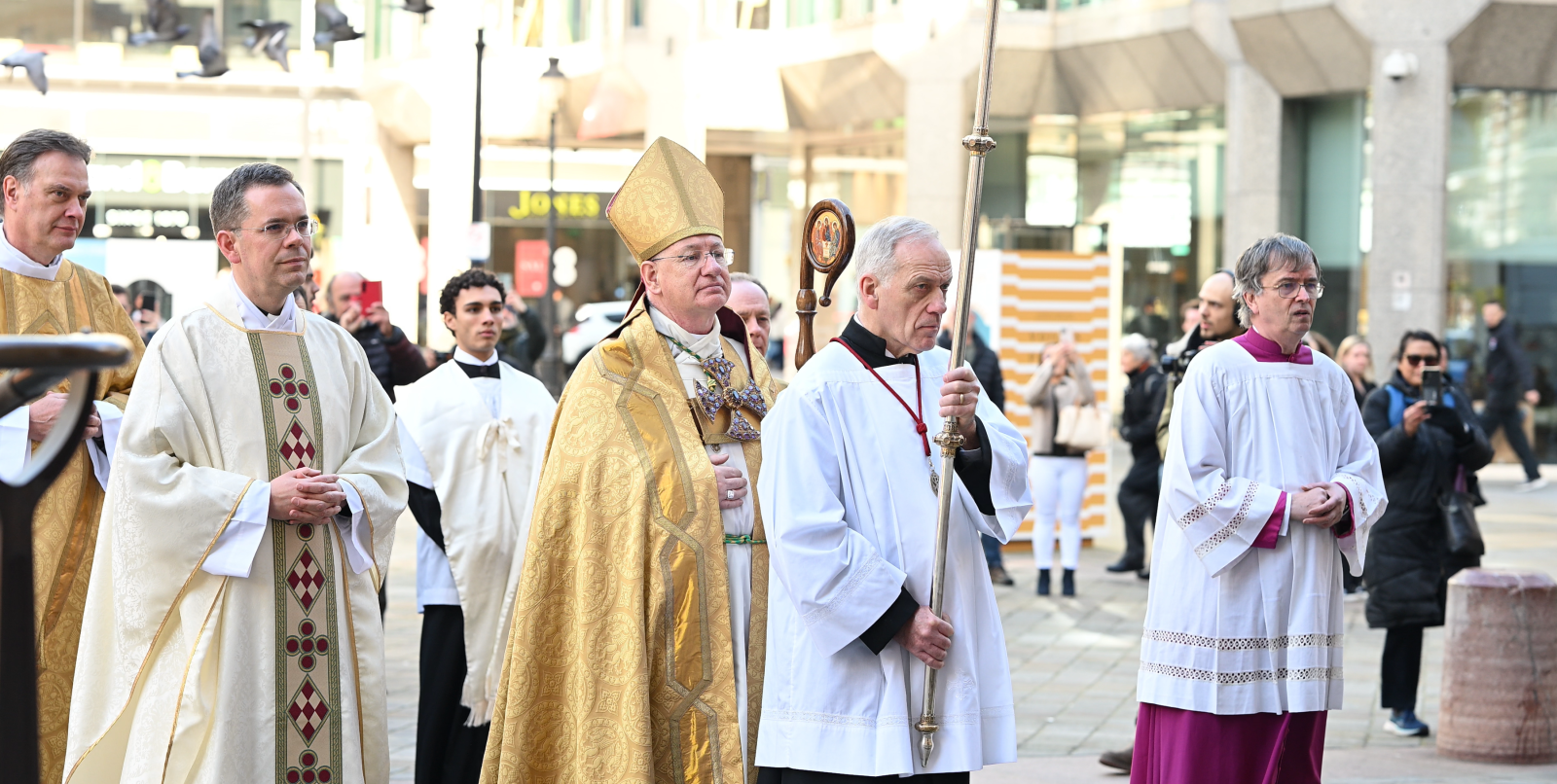
The Most Reverend Richard Moth was today installed as the Twelfth Archbishop of Westminster during a Mass of Installation at Westminster Cathedral at 12 noon on Saturday 14 February 2026.
The Mass of Installation followed a Service of Solemn Vespers held in the Cathedral on Friday evening, attended by clergy, religious, and representatives of schools, parishes and Catholic organisations from across the Diocese of Westminster.
To the sound of a fanfare specially composed by Simon Johnson, Master of Music, Archbishop Moth entered the Cathedral through the Great West Door and was greeted by the Provost, Canon Shaun Lennard.
The rite of reception draws on an ancient Pontifical used at Canterbury during the time of Archbishop Chichele (1414–1443). It has been customary in Westminster since the restoration of the Catholic hierarchy in England and Wales in 1850 and the appointment of Nicholas Wiseman as first Archbishop of Westminster.
The moment of Installation followed the public reading of Pope Leo XIV’s Apostolic Letter by Canon Jeremy Trood, Chancellor of the Diocese of Westminster. Canon Lennard then pronounced the formula of Installation:
By his authority I, Shaun Lennard,
being Provost of the Metropolitan Chapter of Westminster,
do install you, the Lord Richard,
Archbishop in this Church of Westminster,
in which may our Lord Jesus Christ
guard your going in from henceforth,
now and for evermore.
Following the Installation, the Archbishop-Emeritus, Cardinal Vincent Nichols, presented Archbishop Moth with the Westminster crozier, symbol of his office as bishop. The Provost and Canons of the Metropolitan Chapter then greeted the new Archbishop, followed by representatives of the diocesan clergy, ethnic chaplaincies, and pastoral and administrative bodies.
The Archbishop of Canterbury, Dame Sarah Mullally, then greeted Archbishop Moth on behalf of the co-presidents of Churches Together in England, offering a word of welcome:
‘I stand here also as one who has recently been confirmed as Archbishop of Canterbury and who awaits installation. In the months ahead, you and I will share a particular responsibility as Presidents of Churches Together in England, and I very much look forward to working with you to deepen our relationships and to strengthen our shared Christian witness.’
Following the conclusion of the installation rite, Archbishop Moth celebrated a Pontifical Mass. The prayers and readings were those of the Feast of Saints Cyril, Monk, and Methodius, Bishop. The Gospel was proclaimed by Deacon Paul Christian, Cathedral Chaplain and Family Link Worker for Caritas St Joseph’s. The Mass Deacons were Deacon Adrian Cullen, Director of the Diaconate Programme for the Diocese of Westminster, and Deacon Jon Harman, Formation and Spirituality Adviser for the Diocese of Arundel and Brighton.
In his homily, Archbishop Moth called on the Diocese to “fan into flame the gift of God,” reflecting on Saint Paul’s exhortation that “God gave us a spirit not of fear, but of power and love and self-control.”
He emphasised that the power given by the Holy Spirit is not one of domination, but of service, a self-giving love modelled on Christ. He emphasised that the Church’s mission flows from prayer and the Eucharist, and that the gifts received in Baptism and Confirmation are to be lived out courageously in daily life.
He called on the Diocese to renew its commitment to evangelisation, ensuring that the light of the Gospel shines in parishes, schools, homes and workplaces, and in the public square. He encouraged engagement with the pressing issues of our time, including peace, human dignity, the right to life at every stage, the protection of the vulnerable, the plight of refugees and care for creation.
Acknowledging past failures, especially where the vulnerable have been harmed, the Archbishop reaffirmed his commitment to safeguarding, accountability and learning from those who have suffered.
Marking the Feast of Saints Cyril and Methodius, he reminded the faithful that mission must be rooted in prayer, sustained by the Eucharist and marked by patience and perseverance. Concluding, he expressed hope that the Diocese of Westminster will continue to serve Christ and society by fanning into flame the gift of the Holy Spirit, nurtured through prayer.
The Bidding Prayers were read by representatives of diocesan services, including Caritas Westminster, the Education Service, Westminster Youth Ministry, the Safeguarding Service, the Agency for Evangelisation and the Communications Office.
The altar frontal and vestments worn by Archbishop Moth and the Deacons were made by Watts & Co in 2009 from specially woven gold fabric featuring Byzantine-inspired designs based on vestments in the Cathedral collection created in 1928 for Cardinal Bourne.
The principal chalice used by the Archbishop dates from 1529 and was crafted in silver-gilt during the reign of King Henry VIII, predating the Reformation. Donated to the Cathedral by Baron Antonio French and his sisters, it has traditionally been used on Maundy Thursday and in recent years at the Ordination of Priests.
The Archbishop’s crozier and other liturgical vessels form part of a distinguished set of Italian silver-gilt ecclesiastical plate that once belonged to Cardinal Edward Henry Howard (1829–1892), former Cardinal Archpriest of St Peter’s Basilica in Rome.
Towards the end of the Mass, during the singing of the Church’s great hymn of thanksgiving, the Te Deum, Archbishop Moth was led around the Cathedral to bless the people, and in doing so, paused briefly for prayer at the tomb of one of his predecessors, Cardinal Cormac Murphy-O’Connor, the 10th Archbishop of Westminster (2000-2009), and 3rd Bishop of Arundel and Brighton (1977-2000).
The Diocese of Westminster serves the London boroughs north of the River Thames, stretching from the River Lea in the east to Hillingdon in the west, and including Hertfordshire to the north and the Borough of Spelthorne to the south.
Established by Blessed Pius IX on 29 September 1850, the diocese celebrated its 175th anniversary in 2025. Today, the diocese’s parishes and schools reflect a rich diversity of cultures and traditions. A key part of its mission is expressed through agencies such as Caritas Westminster who support those most at risk of exclusion due to poverty, disability, isolation, and exploitation.