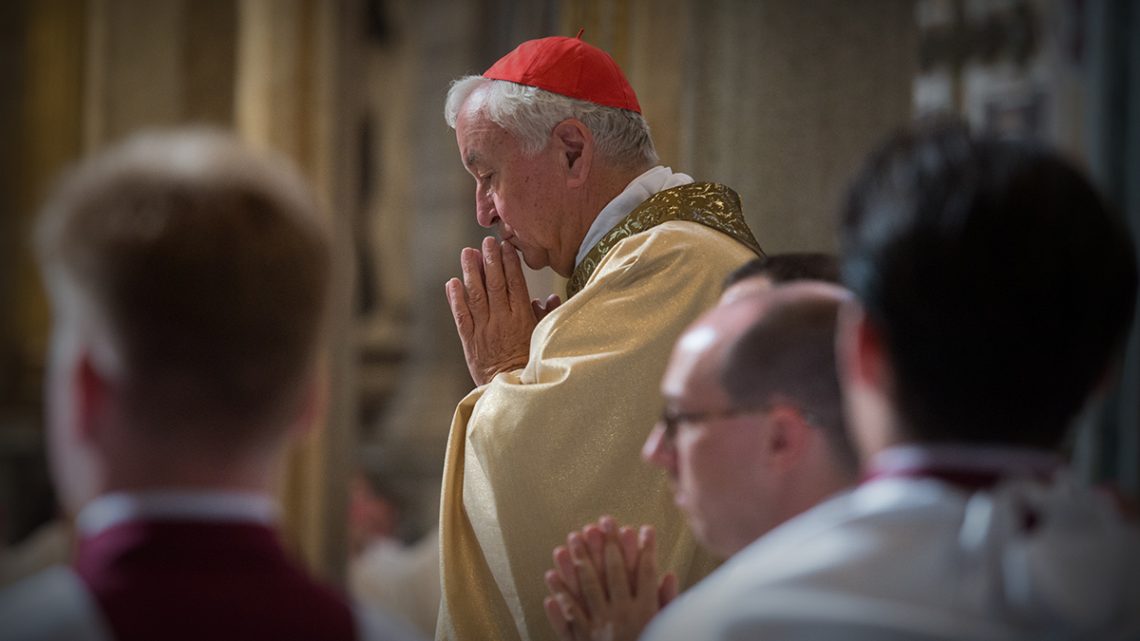
Homily given by Cardinal Nichols on 8 December 2025 for the 175th Anniversary of St Mary's University
This University comes from small beginnings.
It started in Brittany, with 6 students all seeking religious life. Then, in 1850, a more solid start was made, the anniversary of which we celebrate today. Forty men were the first student body gathered in Brook Green under the initiative of Cardinal Wiseman. Only in 1924 was the move here, to Twickenham, eventually made, with 150 students. Today’s University status was granted on 23 January 2014. And still this institution of St Mary’s continues to flourish and expand. So many have benefited from an education here, including my father, who prepared for his teaching career here in the 1940s.
This anniversary year of celebrations has also included other remarkable moments. One of the most important was the elevation of St John Henry Newman to the status of a Doctor of the Church and the proclamation of him as a worldwide patron of Catholic Education.
Now there is one thought of John Henry Newman that is very well known and a key to his understanding of education, especially University education. It is this: ‘God has created me to do Him some definite service.’ You may be familiar with this already. It points to the underlying motive behind
Catholic education, and especially your time of education here at the University: to help you to discover and prepare for that definite service for which you have been given the gift of life.
This proposal invites us to think more deeply about the purposes of education, especially here at St Mary’s. Education is not simply to train future workers, although developing a professional competence is important. It is not simply to make us able to navigate modern society by being competent in the technologies which shape our lives: computers, internet, artificial intelligence. Rather, its purpose is to help us all to be rounded human beings, with a sense of purpose and fundamental principles by which we will make decisions and fashion our contribution to society.
Now this only comes about in the context of friendship and community. At a good university, staff and students genuinely relate to each other rather than simply trying to hand over knowledge or leave students to their own devices. That is a real temptation today when we may find ourselves interacting not so much with other people but with machines, with technology, everything being mediated through the internet. Useful as they are, nothing can replace the face-to-face relationships through which we grow, learn wisdom, discover our strengths and weaknesses, and practise kindness and compassion – or fail to do so!
We find our true purpose in life not by being and thinking alone, not by the radical individualism of today, but by
working together, striving together, serving together. Don’t believe the modern heresy that we human beings are autonomous individuals, making our own individual way through life and into the death we think we choose, living and dying in splendid isolation, sometimes called ‘freedom of choice.’ No, we depend on each other, we recognise the distinctive gifts each has been given, and we try to bring them into a harmony of living and working.
This is the setting in which we grow, discovering the areas of competence we can develop around our key subjects and interests. This is the setting in which we learn about our weaknesses, in which we get to know how to be truly helpful to one another, in which we develop the resilience – the toughness – that we need as we face our challenges.
So, let me repeat: ‘God has created me to do Him some definite service’ – something He has not asked anyone else to do, something particular to me, yet something to be achieved only in partnership with others, in cooperation and shared endeavour.
Now there is a shining example of this at the heart of our Mass today: the figure of the young woman, called Mary, who was summoned by God to an extraordinary task. As we heard in the Gospel, she was attentive to the movements of her heart, to the call of God, and responded generously. From that moment on she lived with a sense of purpose, not excluding challenge and difficulties, but guiding her to become her true, unique self and our blessed Mother in our
life of faith. Today’s Feast of her Immaculate Conception celebrates that the definite service for which God created her took its effect from the very first moments of her life, the moment of her conception.
And she is the Patron and Queen of this University. We praise her in word and song today and we do so with thanksgiving, asking for her protection and guidance as we, in our turn, find our way through life.
Now, one more step. The purpose of God for Mary of Nazareth was to bring His divine life into this world, into this flesh and blood which we all share. She was to bring us Jesus of Nazareth, her Son in the flesh, and the fullness of God, whom we call the Son, the Eternal Word, one with the Father and the Holy Spirit. It is through this Eternal Word that all things are brought into existence and sustained in life. It is through this same Word, now in our flesh, that our flaws and sins are healed and our hope constantly restored.
When declaring St John Henry Newman to be the Patron of Catholic Education, Pope Leo said that through education we learn how to discover in the life of Jesus a ‘horizon of meaning capable of shining a light on all forms of knowledge.’ In other words, this Jesus, through whom all things are created and in whom all fullness is to be found, is the very best of teachers, the supreme teacher who can lead us like no other. He leads us into the most profound truths about our world and about ourselves: its purpose, its design, its fragility, its destructiveness – which we see around and
within us and of which we need to be so aware – and the potential greatness which is proper to each one of us. Pope Leo said: ‘We are disciples and in His “school.”’ May our schools and universities always be places of listening to his Gospel and putting it into practice.
So, it is, that as we celebrate this anniversary of St Mary’s, we stand before this image of our finest teacher, our true companion and guide, the one we rightly call Lord and Master, Jesus the Christ. We celebrate His coming at Christmas and we remember with awe that He calls us to greatness of mind and heart and, in the words of Pope Leo, to ‘shine like stars in the world today.’
May God bless you all. May God bless this fine University of St Mary and prosper it in all its ventures and achievements.