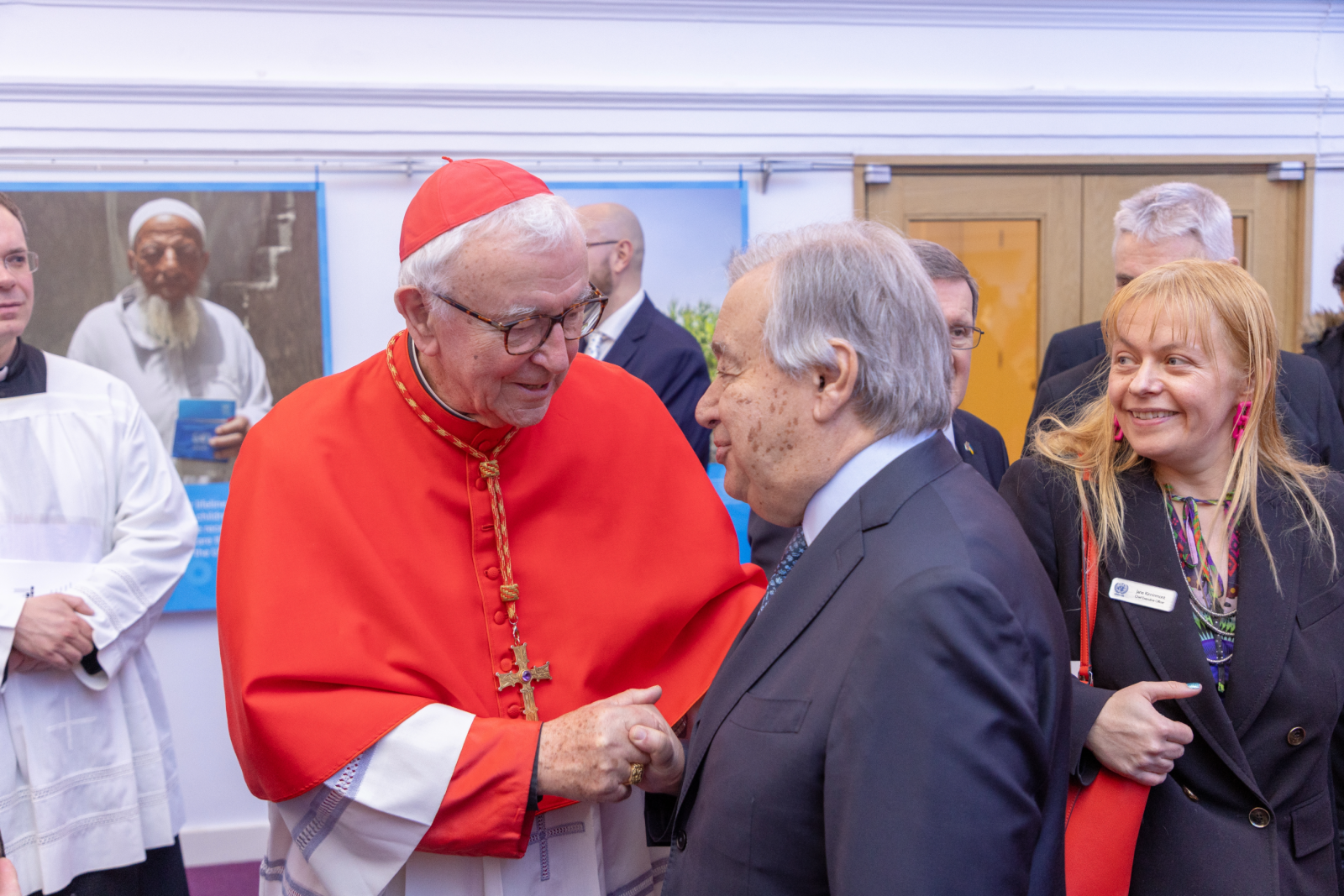
Given on 17 January 2026 at Methodist Central Hall for a Service of Thanksgiving on the 80th Anniversary of the Inaugural Meeting of the United Nations.
Your Royal Highness, Your Excellencies, distinguished guests, ladies and gentlemen, dear friends,
It is a great privilege to stand before you today in this Hall, where exactly eighty years ago the seeds of a fresh global framework were sown. On 10 January 1946, as the echoes of the Second World War still reverberated across a shattered continent, representatives from fifty-one nations gathered here, not as victors and vanquished, but as wayfarers on a shared path towards peace. They came to shape the United Nations, an audacious dream born of necessity: that humanity, scarred by unimaginable loss, could choose cooperation over conflict and dialogue over destruction. Today, we gather in thanksgiving – not merely for that moment, but for the enduring flame it kindled, a light that continues to guide us through our own troubled times.
As we look back on 1946, let us honour those who gathered in this Hall. They were not superheroes cloaked in invincibility, but ordinary souls burdened by the extraordinary grief of families torn asunder, cities reduced to rubble, a world that had lost faith in its own goodness. Yet here, in this Methodist sanctuary – a beacon of the Gospel’s call to justice and mercy – they dared to envision something greater. The United Nations was no abstract treaty; it was a covenant, etched in the memory of the horrors of the Holocaust, the firebombing of Dresden, Coventry and Tokyo, the atomic clouds over Hiroshima and Nagasaki. It declared, with quiet defiance, that vengeance yields only ashes, while diplomacy ploughs the soil for renewal. They pledged ‘to save succeeding generations from the scourge of war’ (Preamble of the Charter). One delegate later wrote of kneeling here in prayer, whispering for wisdom beyond borders.
Eighty years on, that vision endures, embodied in your presence here, Your Royal Highness, Your Excellency António Guterres, Secretary-General of the United Nations, and representatives of His Majesty’s Government, diplomats from across the globe, civic leaders, students and members of the public. Your presence reminds us that peace is not simply the concern or privilege of the powerful, but a cornerstone of the protection and enjoyment of fundamental human rights for every person. Looking again at the candles that have been lit, we thank God for the UN’s many works: for the defenders of peace, for its tireless workers, for aid workers and their agencies, and for the patient work of mediators. Moments from these eighty years come flooding back: blue helmets in Cyprus, mediating the Cuban missile crisis (an afternoon which I remember vividly as a student at school), feeding millions in Ethiopia, and vaccinating billions in the shadow of COVID. These are not metrics; they are mercy made manifest, threads woven into a tapestry of hope.
Yet, as people of faith, we cannot shy away from honest reckoning. Today, multilateralism faces fierce headwinds. Conflicts rage from Ukraine, across parts of Africa, in the Middle East; climate accords are stalled; and the digital age fractures our shared truths into echo chambers of division. We hear proclamations of peace yet see aggression used as its means. But such proclamations are only for a peace that suits the aggressor. The very idea of nations working with trust, purpose, accountability and patience feels, at times, like a whisper against the clamour of nationalism and protective isolation. This we see also in the plight of refugees turned away at borders and in the erosion of trust that once bound us together. How, then, do we rekindle the spirit that once found expression in this Hall?
Here, the Christian faith offers a timeless compass. The Gospel we have heard reminds us that the work of peace begins in the heart of every person. St Paul puts before us the behaviour that is needed: mutual respect and service, hospitality to the stranger, patience, empathy, freedom from revenge, the pursuit of the noble and the good.
In this belief, peace is a gift which is both present and ultimately victorious. ‘Peace is the breath of the eternal: while to evil we cry out “Enough”, to peace we whisper “Forever”.’ (Message of Pope Leo XIV for World Day of Peace, 1 January 2026). When peace becomes a principle that guides and defines our choices, then that profound sense of the unity of our human family is refreshed. And this unity is not simply a political expedient, but a divine imperative. Our search for peace and our prayer for unity are inextricably bound together.
‘With this in mind,’ as Pope Leo XIV said in his address on 9 January 2026 to the Diplomatic Corps accredited to the Holy See, ‘the United Nations has mediated conflicts, promoted development and helped States protect human rights and fundamental freedoms. In a world facing complex challenges such as geopolitical tensions, inequalities and climate crises, the UN should play a key role in fostering dialogue and humanitarian support, helping to build a more just future. Efforts are therefore needed to ensure that the United Nations not only reflects the situation of today’s world rather than that of the post-war period, but that it is also more focused and efficient in pursuing policies aimed at the unity of the human family instead of ideologies.’
Today, then, we pray for the gift of renewal, remembering the words of St Paul, not known for his timidity, when he tells us, ‘do not claim to be wiser than you are.’ In this renewal, belief in God is not a problem to be solved, but a great resource to be rediscovered. Here, then, we pray for peace, which is always the work of God; for dialogue and cooperation between nations for the common good, the good from which no one is excluded; for the renewal of our international institutions so that national and international power may be used in the cause of a lasting peace based on justice, on respect for the dignity of every person, and on compassion for the poorest in our midst. Then we shall all breathe more easily and readily give praise to God.
May the God of all nations bless these endeavours, unite our wills and guide us so that dialogue may prevail and peace be our common inheritance.
Amen.
✠ Cardinal Vincent Nichols
Archbishop of Westminster