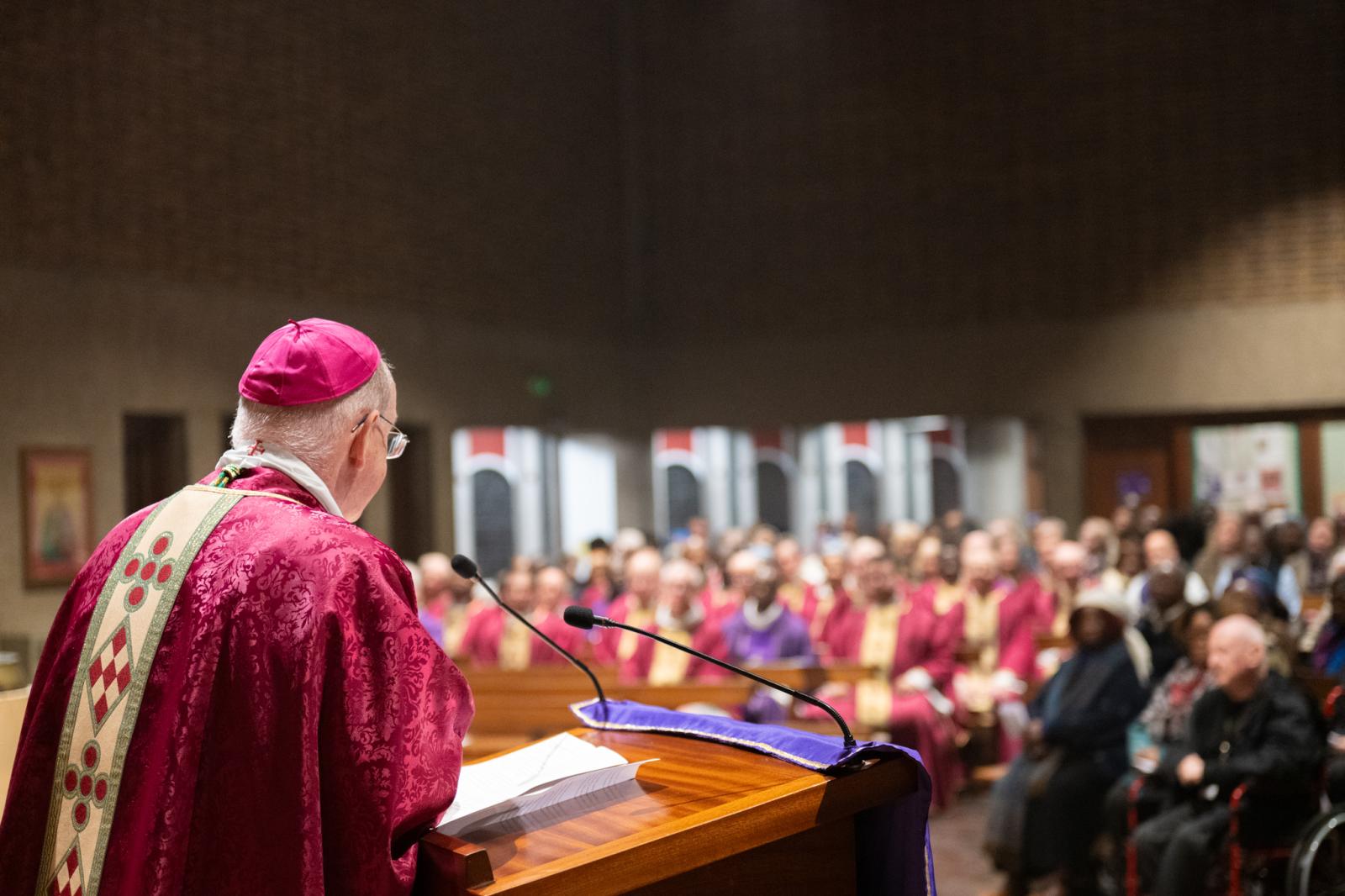
Homily given for the Mass of Welcome at Wood Green Parish on 4 March 2026.
Dear Brothers and Sisters,
Although we seem to hear it less these days, the name of Jeremiah has come into the English language as a description of someone who sees things from a gloomy perspective. Today’s first reading suggests something of the reason why. Jeremiah was sent by God to warn the chosen people and his message was not welcomed. Jeremiah’s plea to God, ‘should good be repaid with evil?’, indicates the depth of his distress. He has done is very best. All he receives in return is insult and rejection.
As we look at the Old Testament through the lens of the Gospel and in the light of Christ, we come to recognise that the Old Testament points us to the person of Jesus. In today’s Gospel, Jesus warns the twelve that He will receive the ultimate rejection, He will be put to death. Emmanuel, God-with-us, the Word there at the beginning of all things, the Second Person of the Blessed Trinity, Jesus Himself, will be crucified. Where Jeremiah experienced insults, the Christ will be insulted, scourged, spat at and put to death in the most barbaric way available at the time.
St. Paul, writing to the Corinthians, tells them that he preaches the Crucified Christ (1 Cor 1:23). Is not this a paradox? Jeremiah’s message was rejected since the people did not want to hear it. The image of a crucified man is deeply unattractive, we recoil from it. Yet, like Paul, we preach a Crucified Christ. Our churches and homes are adorned with the Crucifix and we wear them around our necks too. While the image of crucifixion is disturbing, to say the least, we recognise that this death, the death of Jesus, the One who is without sin, is the image not of death, but of love.
St. Paul, writing to the Romans, explains this for us: “It is not easy to die even for a good man, though of course for someone really worthy, a man might be prepared to die, but what proves that God loves us is that Christ dies for us while we were still sinners.” (Rm. 5:7-8)
There, brothers and sisters, is the wonder and the beauty of the Cross. It is forgiveness and salvation, through the death of Jesus, Son of the Father. As the Passiontide hymn of the 6th century expresses it: “Hail, Cross of Hope the most sublime!” (VENANTIUS FORTUNATUS, Vexilla Regis Prodeunt, v.2.) The Cross is the sign of contradiction. The instrument of death becomes, in Christ, the instrument of life. Jesus’ death is nothing less than our salvation.
The season of Lent calls us to reflect more deeply on the mystery of the Cross that is the proof of God’s love. Let us make the best possible use of this time. The practice of making the Stations of the Cross will help us. If we cannot join in making this devotion in church, we can make the stations at home, there are many publications and prayers that can help us.
Reflection on Jesus’ saving work upon the Cross is important for reasons beyond our individual devotion, for we are called to follow the example of St. Paul and preach the Cross of Christ. While for priests and deacons this will be done through preaching, all our called to witness to the Cross and to the salvation that Jesus has won for us. This is the task of the whole Church. It is the mission of the Christian, the work of our parishes and our Diocese, that all may come to rest at the foot of the Cross of Christ and, through the salvation that Jesus has won for us, know the wonder of the Resurrection.