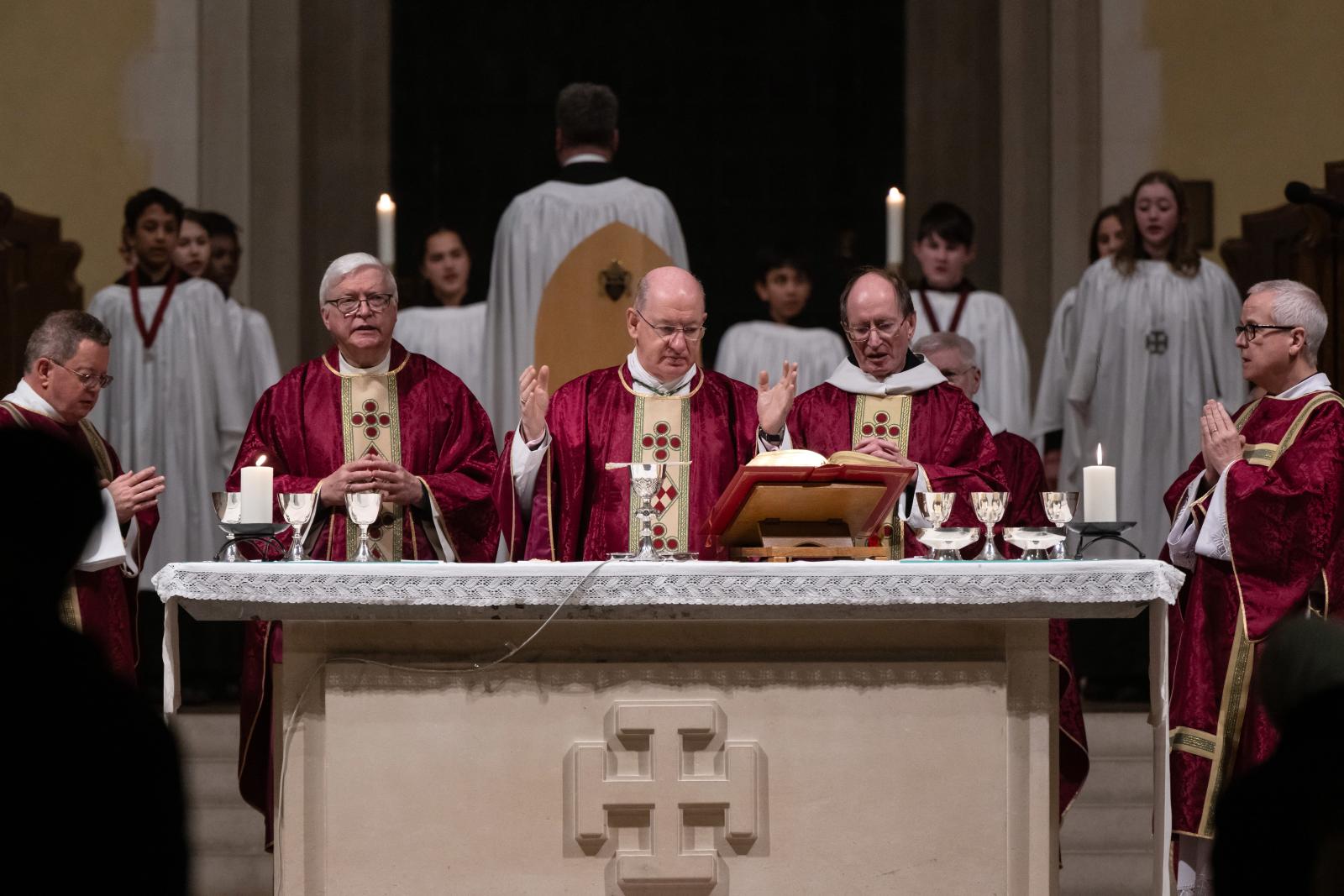
Homily given for the Mass of Welcome at Ealing Abbey on 26 February 2026.
Dear Brothers and Sisters,
Those of us who pray the Divine Office, the Prayer of the Church, benefit from reading the book of Esther at the Office of Readings, but the book appears rarely in the Lectionary for Mass. Queen Esther finds herself pleading before the rather brutal Ahasueus, King of Persia, for the life of the Jewish people. Her bravery in this action brings about the Jewish Festival of Purim.
Today’s first reading gives us the prayer that Esther offers to God, recognising that only in Him can she hope to save her people. Her prayer is also accompanied by fasting. Her one and only aim is the salvation of the Jewish people: she is motivated by service.
Our responsorial Psalm is a celebration of the way in which God answers our prayer just as he answered the prayer of Esther. Jesus Himself, in today’s Gospel, tells us without ambiguity: “For everyone who asks receives; the one who seeks finds; to the one who knocks it will be opened.”
The words of Jesus and the example of Esther call us to have complete confidence in the power of prayer. The journey of prayer is a deepening of the relationship to which the Lord invites us. He will always be present, attentive, listening, knocking at our door. Our response to his invitation will sometimes be lukewarm, questioning, impatient. Sometimes, on our part, prayer will grow from a place of anger or an attempt to bargain with God. Yet prayer offered in trust and from a pure heart will always be answered. It may not be answered on our own terms, or in ways we expect, but the Lord knows and understands us more than we do ourselves and His response will be grace as He sees fit.
Prayer is one of the three foundation stones of Lent and, like Queen Esther, and at the Lord’s bidding, we add to prayer: fasting and service of our brothers and sisters (almsgiving). Our Lent recalls Jesus’ forty days in the desert. This was a time for Him of intense prayer and sometimes our prayer is, like His, a desert experience. At such times, one thing is asked of us, to “Walk in silence behind the Guide.” (as a Carthusian monk once put it). Our prayer need not always require many words, for the Lord knows what we need before we even ask him, sometimes prayer is expressed in fidelity, rather than in words that can be difficult to find.
Just as Queen Esther came to realise what her mission needed to be and prayed in complete trust for the courage to fulfil it, so we must pray in complete trust for the strength to fulfil the mission we have been given.
What is this Mission? It is witness to the Gospel, each of us according to the vocation to which we have been called and using the gifts and talents with which we have been graced. This mission is for every one of us and in every setting in which we find ourselves: parish, home, school, workplace and in the everyday encounters and conversations that come our way. Like Esther, our prayer will strengthen us for our mission and, as with her, there will be times when courage is needed.
Let us, both as individuals and in our various communities, recommit ourselves to the task at hand. This demands of each of us a renewed spirit of conversion and repentance expressed in Lent through fasting and celebration of the Sacrament of Penance. It demands for each of us a renewal in prayer, for without prayer we can do nothing. It demands an ever-greater openness to service of our brothers and sisters, in Lenten almsgiving surely, but beyond that in the gentle, yet consistent and sometimes courageous, witness to the wonder of the Gospel and all that flows from the saving sacrifice of Christ Himself.
May we be blessed in this great work the Lord has given us to do.
Image: Mazur/cbcew.org.uk