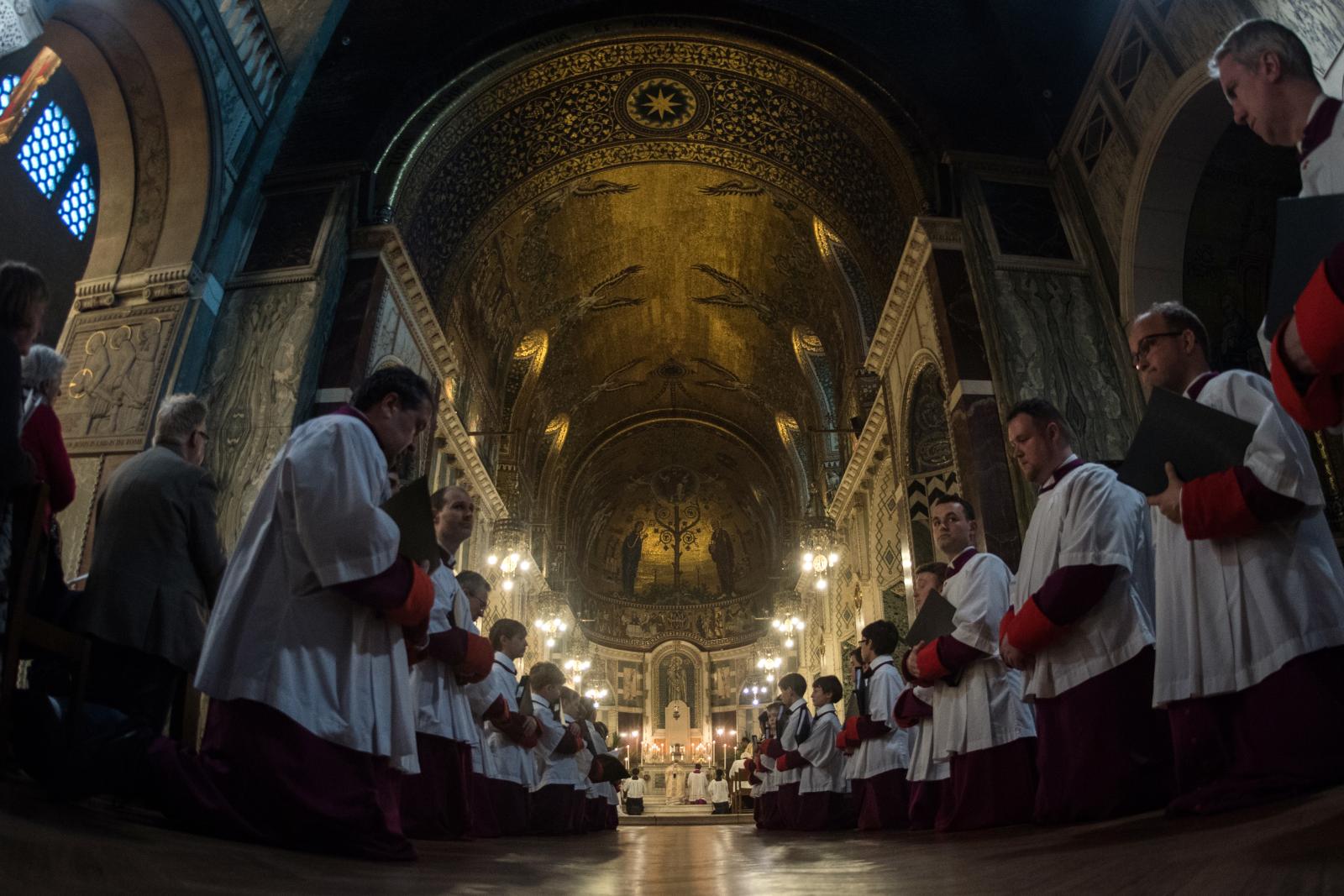
Given on 2 April 2026 at Westminster Cathedral for the Mass of the Lord's Supper.
Dear Brothers and Sisters,
On Palm Sunday, we entered Jerusalem with the Lord. This evening, we are with Him in the Upper Room as he celebrated the Passover with the twelve. They gathered to celebrate the event reported in this evening’s first reading, the meal that the chosen people in Israel would eat, in haste, as they prepared for their departure from slavery in Egypt.
In Jesus, the Passover meal takes on a new significance and we see in the events taking place in Egypt a prefiguring of all that we celebrate over these coming days. As they eat the Passover meal, the chosen people are about to be delivered from slavery in a foreign land. The Lord, in his passion and death, delivers the whole world from slavery to sin and death, opening the way to our true home in the Kingdom. The lamb that is to be eaten is, we are told, to be without blemish. Jesus, whom John the Baptist announces as the Lamb of God, is Himself without blemish, for He is without sin. Just as the lamb of the Passover meal was to be eaten in its entirety, so the Lord gives all of Himself for us, to the very last drop of his blood. As the blood of the Passover lamb is to be put on the door posts and lintels of the houses, so the blood of Jesus is spilt on the cross.
The Passover in Egypt pointed the way to Jesus’ self-giving for our sakes. Jesus, in his celebration with the disciples, in his celebration of the Passover with his friends, transformed it from the customary celebration. He firstly took onto Himself the role of the lowliest servant, that action of washing the feet of the disciples. They would already have done this, on their way in from the dusty streets of the city, but he carried out this action, as he makes clear, as a sign and as example. This is the new commandment, the mandatum, that if we are to be his disciples, we must be servants of all.
The Lord is, so soon after the Last Supper, to be arrested, suffer and die. This is the depth of His service to the whole of humanity at every moment in history. When we live out the commandment that he models in the washing of the disciples' feet, we are, in a small way by comparison, giving of ourselves in service to Him whom we recognise in our brothers and sisters. Every act of service on our part is a following of Jesus in His sacrifice for us.
We might be forgiven for wondering why St. John did not write of the Eucharist in his account of the Last Supper, while the over evangelists did. St. John records the words of Jesus about Himself as the Bread of Life in the 6th chapter of his gospel. St. Paul, whose text from the First to the Corinthians we have heard this evening, is the first account of the Eucharist to be written, perhaps ten years before St. Mark wrote his Gospel. His text tells us what the early Church was doing in celebrating the Eucharist and, when we compare this with the texts in Matthew, Mark and Luke, we see so clearly how Jesus’ instruction at the Last Supper was carried out in the early Church, and has continued to be carried out to our own time, and will be into the future.
The gift of the Eucharist is beyond our imagining. It is also wonderful in its simplicity: “This is my body ... This is my blood.” The bread and wine of the Passover meal, given to sustain the chosen people on their journey, Jesus transforms to be the gift of Himself for our journey. Jesus, who gives Himself for us on the Cross, gives Himself to us in the Eucharist. In receiving Him, we are one with Him and thereby one with each other. It is from the Eucharist, therefore, that our action as His Church flows.
As we move from the celebration of this Mass of the Lord’s Supper to watch with Him in the hours before midnight, may we be ever more open to the reality of his self-giving. Strengthened by the gift of the Eucharist and renewed in our commitment to service, may our prayer be that of Jesus in Gethsemane: “Not my will, but yours, be done,” that our lives be fruitful in His service as we continue the mission to which we have been called. What is this mission? It is nothing less than, in every word and action of our lives, the proclamation of the mystery of His saving passion and death, and the new life and light of his resurrection, to the whole world.
Image: Mazur/cbcew.org.uk