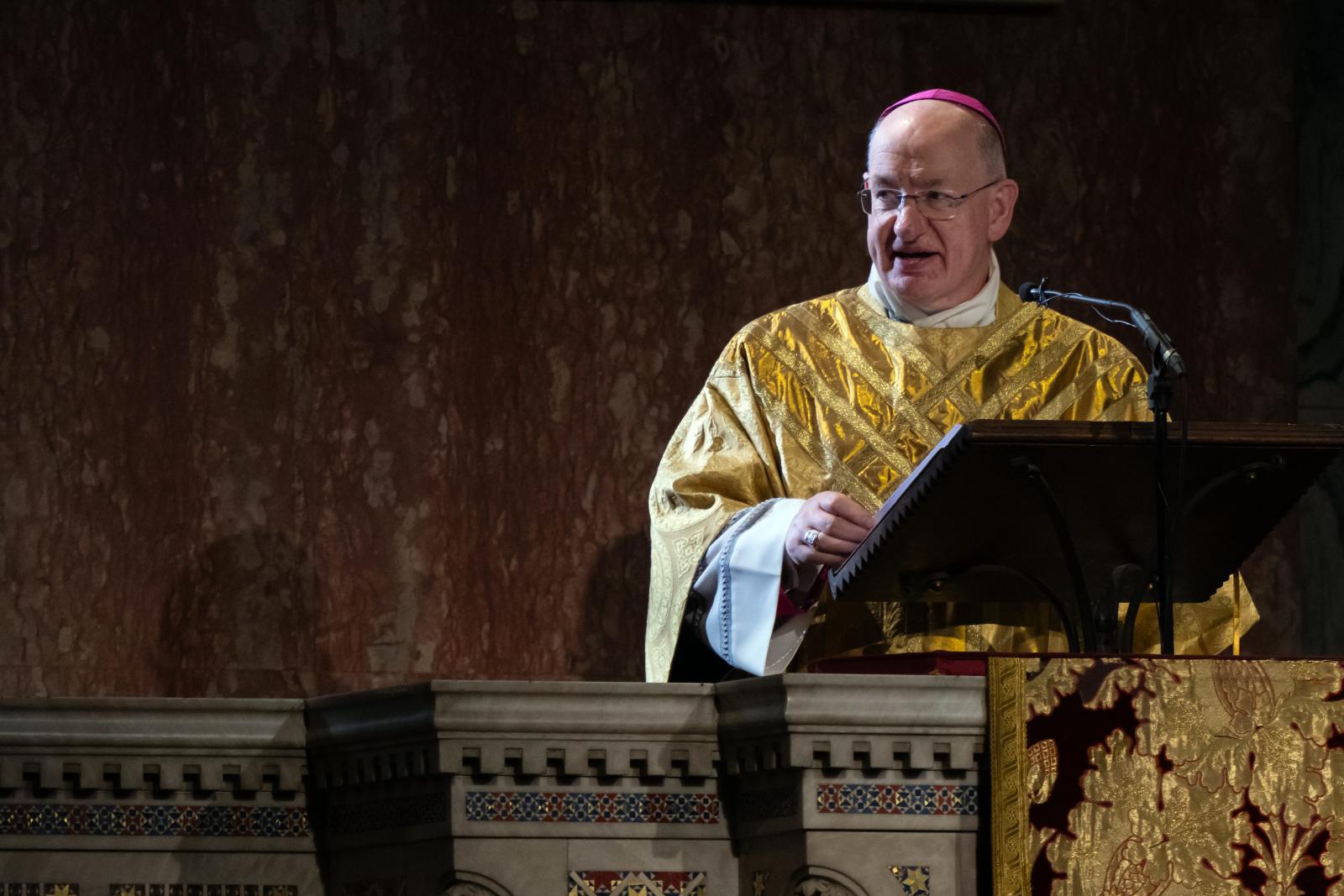
Given on 14 February 2026 at Westminster Cathedral for the Mass of Installation of Richard Moth as Twelfth Archbishop of Westminster.
Dear brothers and sisters,
On 25th March 1976, I was privileged to be in this great Cathedral Church, together with a friend from school, who is also present here today, for the Episcopal Ordination of the late Cardinal Basil Hume. On that day, the text that we have just heard, from St. Paul’s second letter to Timothy, was proclaimed: “Fan into flame the gift of God… for God gave us a spirit not of fear, but of power and love and self-control.” (2 Tim 1:6-7)
God’s call to us is not a call to power as so often exercised in the world, to achieve dominion over others. Rather it is characterised by self-control, not a self-control ‘generated’ as it were from within ourselves, but a self-control guided, empowered by the Holy Spirit. It is characterised by love, a love that reflects to all the love that we see in Christ. This is a love that is total-self-giving, self-emptying to the point of the death that we see depicted so clearly in the great rood here, above the Sanctuary.
This is Christ-like Service, that brings Faith, Love and Hope to a world that, in our present age, cries out for Hope. This Service is our Mission as Christ’s Church. St. Paul reminds us that we receive the gifts that come to us through the Holy Spirit, often experienced in gentleness and in the silence of prayer. These gifts are experienced in their fullness, fanned into flame, through our living out of the Mission to which we are called.
We receive the grace of the Spirit through Baptism and Confirmation, as well as through the Sacrament of Holy Orders, so the words Paul spoke to Timothy are for all of us today. I ask you to join with me in giving thanks for the witness to the Gospel in this Diocese over so many years, not least in the life of Cardinal Vincent as he moves to more restful pastures. We all have so much for which to be thankful, so much on which to build. I rejoice that the Lord has called me to share with you, people and clergy of this Diocese, the mission He has given to us. It is the same mission that He gave to the seventy-two.
Just as the Lord called the seventy-two, so he calls us to go out into the world of our own age, carrying with us the message of the Gospel of Peace. Let us ensure that the light of the Gospel shines brightly in our parish communities, in our homes and our schools. At every opportunity, let us shed the light of the Gospel on the world of our day, in our universities, our places of work.
Let us not be afraid to shine this light in the public square for, as Pope Benedict XVI reminded us when he spoke in Westminster Hall in 2010: “The world of reason and the world of faith…need one another and should not be afraid to enter into a profound and ongoing dialogue, for the good of our civilisation. Religion…is not a problem, but a vital contributor to the conversation.” This encounter will, at times, require the boldness that we see in Paul and Barnabas in today’s first reading, but we need not fear. The great questions of our time: the need for all peoples to live in peace, the value and dignity of every person, the right to life at every stage, the protection of the vulnerable, the plight of the refugee and the dispossessed, the protection of our common home, all of these call for the light of the Gospel to be shone upon them. This task is intrinsic to the work of evangelisation.
This work of evangelisation is vital, but it is fragile and adversely impacted by our failures in love, power and self-control. Here I am most aware of every occasion on which members of the Church, or the Church as a whole, have failed, most especially when the vulnerable have been abused. Such failure calls for listening to and learning from those who have suffered so grievously and a continuing commitment to ensuring that our communities are places where all are safe in their encounter with Christ and with one another.
The reality is that the power of the Church is the power of service. It is the power of service in the way that Jesus serves, emptying of self for the salvation of all.
It is the Spirit who guides our work and we celebrate today the lives of two saints, Cyril and Methodius, who have much to teach us on our journey. Two brothers, born in Constantinople, they answered the Lord’s call to evangelise the peoples of Moravia. Their work in the translation of the Liturgical texts into Slavonic reminds us all that our lives in Christ must be rooted in prayer and in the celebration of the Sacred Liturgy. It was from this grounding, this foundation in prayer that the mission of these two brothers would flow and for Methodius in episcopal ministry. He went to Pannonia (modern day Hungary) where he was zealous in his work of evangelisation. He faced difficulties, but persevered free from fear, guided and strengthened by the Spirit.
As with these two great saints, so it is for us. It is in the Eucharist that Jesus nourishes us with His very self for our work as His disciples. It is from the Eucharist and from prayer that our work of evangelisation flows, for evangelisation is a call to a relationship, the relationship with the person of Jesus Christ. The seventy-two had walked with Jesus, sat with Him, listened to Him. We must, therefore, walk with Jesus on the journey of prayer, listen to Him in the Scriptures, sit with Him in Adoration of the Blessed Sacrament, welcome Him in the Eucharist. These are gifts beyond our imagining, rooted in the mystery of God’s love. They are gifts we have the privilege and joy to share.
This mission of evangelisation takes time. Pope Francis reminded us that “an evangelizing community is also supportive, standing by people at every step of the way, no matter how difficult or lengthy this may prove to be. It is familiar with patient expectation and apostolic endurance. Evangelization consists mostly of patience and disregard for constraints of time.” So, we need not be concerned to seek for results according to our own timescale. The time we have is a gift from God and He calls us, very simply, to use this gift in Service. May our parish communities, our schools, our chaplaincies, our whole diocese grow as a School of the Lord’s Service[1], service of the One who died and rose from the dead for us and Service of those whom we encounter.
In these present times, we are seeing what some have called a ‘quiet revival’ of faith. The fullness of time will show us the depth of this revival, but it is certainly the case that this is a good moment to be a Christian, a Catholic, a disciple of Christ.
The flame has been given to us, the flame of the Holy Spirit that came upon the infant Church at Pentecost. This flame must be fanned. It must be nurtured through prayer and a deepening understanding of the gift of Faith. Thereby, our mission will grow ever more effective, lived out in total service of our brothers and sisters, in whom we serve the Lord Himself, and in the highest activity of our human lives, the worship of the One Who gives Himself for us and Who calls us to Himself.
[1] cf. St. BENEDICT, The Rule of St. Benedict, Prologue, n.45